Introduction: What is a Ductless Mini-Split?
How mini splits work is simpler than you might think. They are highly efficient heating and cooling systems that don’t require ductwork. Instead, they use an indoor unit and an outdoor unit connected by a small conduit to move heat.
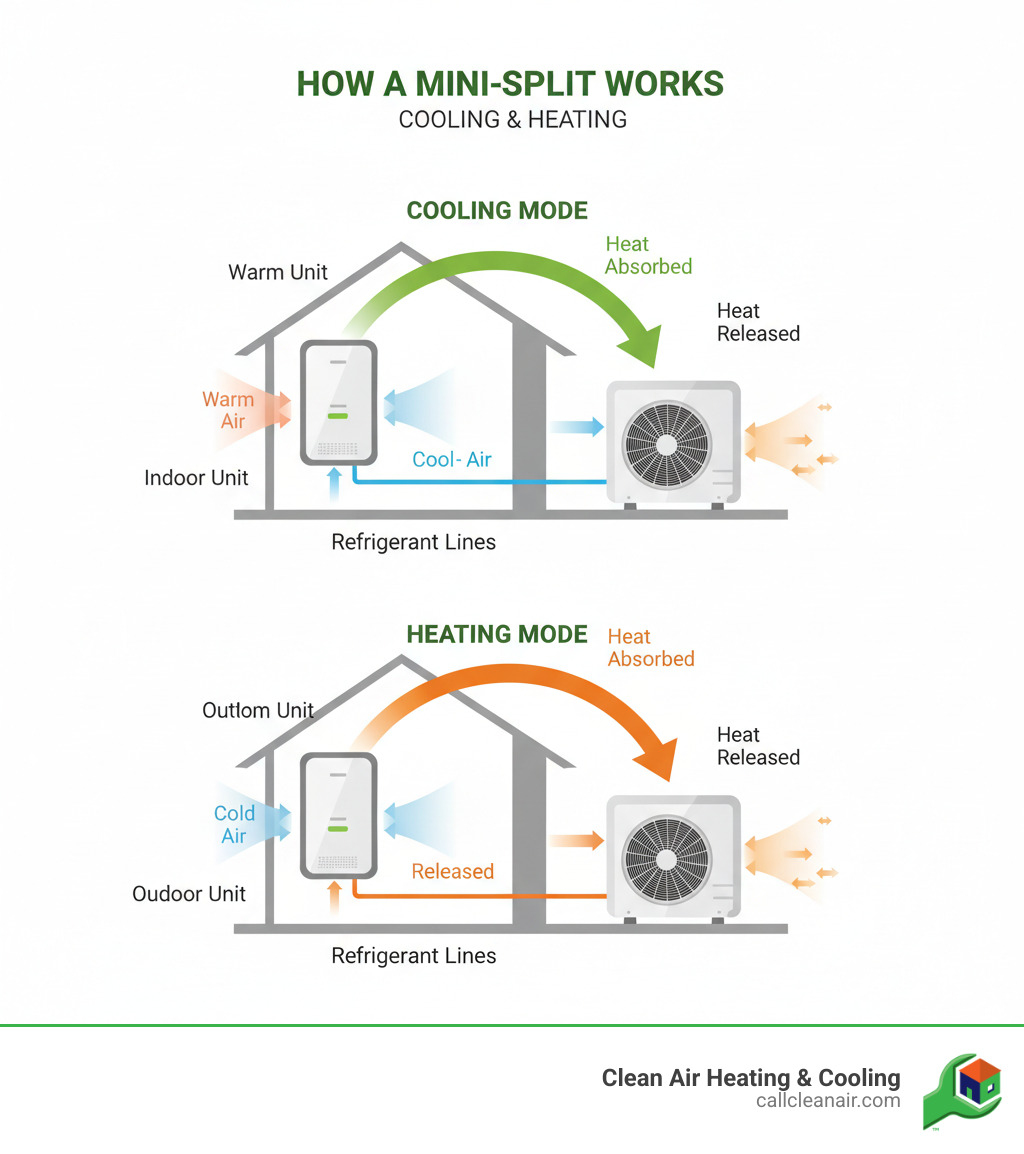
In cooling mode, the indoor unit absorbs heat from your room, and the outdoor unit releases it outside. In heating mode, the process reverses, pulling heat from the outside air (even in cold weather) and moving it into your home. Because they transport heat rather than creating it, they can be up to three times more efficient than traditional systems, allowing for individual room temperature control.
Mini-splits are a flexible solution for room additions, older homes without ducts, or anyone wanting zoned temperature control. They are especially popular here in the Pacific Northwest, where our climate makes heat pump technology very efficient.
I’m Colin Matei, Owner of Clean Air Heating & Cooling. My team and I have helped many homeowners in Bellingham and surrounding communities understand how mini splits work and enjoy their benefits, from consistent comfort to energy savings of up to 30%.

The Science of Comfort: How Mini-Splits Work
At its core, understanding how mini splits work is about moving heat, not creating it. This makes them incredibly energy-efficient. A special fluid called refrigerant cycles between an indoor and an outdoor unit, absorbing heat in one place and releasing it in another. This is called the refrigerant cycle. For a technical overview, the Department of Energy explains how air source heat pumps work.
How mini-splits work to cool your home
In summer, the indoor unit’s evaporator coil gets very cold. As your room’s warm air passes over it, the refrigerant inside absorbs the heat and turns into a gas. The fan then blows the newly cooled air back into the room. This process also dehumidifies the air, making it feel more comfortable. The refrigerant, now a hot gas, travels through a small conduit line to the outdoor unit. There, the condenser coil releases the heat outside, the refrigerant turns back into a liquid, and the cycle begins again.
How mini-splits work to heat your home
In winter, a reversing valve flips the process. The outdoor unit now absorbs heat from the outside air—even when it’s freezing. Modern systems can extract heat in temperatures as low as -4°F. The refrigerant absorbs this ambient heat and is then pressurized by the compressor, which makes it very hot. This hot gas is sent to the indoor unit, where it releases its heat into your room, warming the space. This method of moving existing heat is far more efficient than traditional electric or gas furnaces. For more on their cold-weather performance, see this article on winter-proof heat pumps.
Anatomy of a Mini-Split: The Key Components
To understand how mini splits work, let’s look at their main parts. A system consists of an outdoor unit, an indoor unit, and a conduit connecting them.
- The Outdoor Unit: This is the powerhouse, containing the compressor (the heart of the system) and the condenser coil. It’s responsible for releasing heat outside during cooling and absorbing it during heating.
- The Indoor Unit: This is the part you see inside. It houses the evaporator coil to absorb or release heat, a quiet blower fan to circulate air, and an air filter to clean the air. Regular filter cleaning is crucial for efficiency.
- The Conduit: This is a small bundle of lines that connects the two units through a three-inch hole in the wall. It contains refrigerant lines, a power cable, a communication cable, and a condensate drain line to remove moisture.
Types of Indoor Units
The flexibility of mini-splits comes from the variety of indoor units available, allowing you to choose the best fit for your space. Understanding how mini splits work in different configurations helps you choose the right setup.
- Wall-mounted units: The most common type, installed high on a wall for excellent air distribution.
- Ceiling cassette units: Recessed into the ceiling, these are very discreet and provide four-way airflow, ideal for large, open areas.
- Floor-mounted units: Installed low on a wall, similar to a radiator. They are great for heating and for rooms with limited upper wall space.
- Concealed duct units: Hidden in the ceiling, these use short ducts and vents for a traditional look with mini-split efficiency, perfect for conditioning multiple rooms from a single indoor unit.
Whether you’re looking to cool a single small room or create a whole-home comfort system, there’s an indoor unit style that’ll work for your space.
Ductless vs. Ducted: Advantages and Considerations
When considering any HVAC system, it’s important to weigh its benefits against potential drawbacks. Mini-splits offer a compelling alternative to traditional ducted systems, especially for homes in our service areas of Skagit County, Snohomish County, and Island County. Let’s compare how mini splits work against central air and look at their key advantages and considerations.
| Feature | Mini-Split Systems | Central Air Systems |
|---|---|---|
| Cost | Higher upfront investment; lower operating costs | Lower upfront cost; higher monthly bills |
| Efficiency | Up to 30% energy savings; no duct losses | Can lose over 30% of energy through ductwork |
| Installation | Minimally invasive; 3-inch hole per unit | Requires extensive ductwork installation |
| Zoning | Individual room control; multiple temperature zones | Single thermostat controls entire home |
Major Advantages of Mini-Splits
The biggest benefit is energy efficiency. Because they don’t use ducts, which can lose over 30% of their energy, mini-splits can reduce your heating and cooling costs by up to 30%, according to the U.S. Department of Energy. This is a significant saving, especially in our Pacific Northwest climate.
Another major advantage is zoned comfort. Each indoor unit has its own thermostat, allowing you to set different temperatures in different rooms. This eliminates “thermostat wars” and stops you from wasting money heating or cooling unused spaces. For more on this, see our guide to mini split cooling efficiency.
Finally, mini-splits offer quiet operation and improved air quality. Indoor units are often whisper-quiet, and since there’s no ductwork to collect dust and allergens, the air you breathe is cleaner.
Potential Disadvantages and Considerations
The primary consideration is the upfront cost, which can be higher than for traditional systems. However, these costs are often offset by long-term energy savings. For a detailed breakdown, see our article on how much it costs to install a mini split.
The appearance of the indoor units is another factor. While modern designs are sleek, they are still visible. However, with options like ceiling cassettes and concealed units, there are discreet solutions available.
Lastly, correct sizing and professional installation are crucial. An improperly sized unit will not perform efficiently. It’s essential to have a professional calculate your home’s specific needs to ensure optimal performance. Our guide on what size mini split you need explains why this is so important.
Anatomy of a Mini-Split: The Key Components
To truly understand how mini splits work, it helps to know the main players in this sophisticated system. While they might look complex at first glance, mini-splits are actually quite neatly simple—essentially just two main units connected by a few lines running between them.
Let’s start with the outdoor unit, which is the real workhorse of the system. You’ll find this box sitting outside your home, quietly doing the heavy lifting. Inside, there’s a compressor—think of it as the heart of the system, pumping refrigerant through the cycle and ramping up its temperature and pressure. The outdoor unit also houses the condenser coil, which releases heat to the outside air when you’re cooling your home, or absorbs heat from outside when you’re heating. A fan moves air across this coil to make the heat exchange happen efficiently.
The indoor unit is the visible part that hangs in your living space, and manufacturers have gotten much better at making these look sleek and unobtrusive. This unit contains the evaporator coil, which does the opposite job of the condenser—absorbing heat from your indoor air in cooling mode, or releasing heat into your room in heating mode. A quiet blower fan pulls room air in, circulates it over the coil, and pushes the conditioned air back out. There’s also an air filter that traps dust, pollen, and other particles floating around. In my experience at Clean Air Heating & Cooling, I can’t tell you how many times we’ve seen systems running inefficiently simply because these filters haven’t been cleaned regularly.
Connecting these two units is what we call the conduit or line set—a slim bundle that runs through a small three-inch hole in your wall. Inside this bundle, you’ll find refrigerant lines (copper tubing that carries the refrigerant back and forth), a power cable (to supply electricity to both units), a communication cable (so the units can talk to each other and coordinate), and a condensate drain line (to carry away the moisture pulled from your air during cooling). It’s worth noting that mini-splits don’t need a water supply—they just produce condensate that drains away automatically.
Types of Indoor Units
One of the best things about mini-splits is how flexible they are when it comes to placement. The variety of indoor unit styles available means you can find something that works for just about any space or aesthetic preference. This versatility is a big part of understanding how mini splits work in different home designs.
Wall-mounted units are what most people picture when they think of mini-splits. These sleek units mount high on a wall—typically measuring around 12 inches by 32 inches by 9 inches, so you’ll need at least three feet of clear wall space. Modern designs are far less obtrusive than older models, and some manufacturers (like LG’s Art Cool Gallery) even let you customize the face panel with your own artwork or photo. Pretty cool, right?
If you’re short on wall space or just prefer a more discreet look, ceiling cassette units might be your answer. These recessed units sit flush with your ceiling, with only a small grille visible. They’re particularly nice because they distribute air evenly in four directions, making them great for larger rooms or open floor plans.
Floor-mounted units are perfect when you have limited wall space or low ceilings. They sit close to the ground, similar to a traditional radiator, and they’re especially effective for heating since warm air naturally rises from their low position.
Finally, there are concealed duct units (sometimes called slim ducted units). These hide completely above your ceiling or within a bulkhead, distributing conditioned air through short runs of ductwork to one or more vents. They give you the clean aesthetic of a traditional ducted system while keeping the efficiency advantages of a mini-split. They’re ideal for conditioning multiple rooms without visible indoor units.
Whether you’re looking to condition a small room or create a whole-home solution, there’s a mini-split configuration that’ll work for your needs. Over the years serving homeowners throughout Whatcom, Skagit, Snohomish, and San Juan Counties, we’ve installed just about every configuration imaginable.
Ductless vs. Ducted: Advantages and Considerations
When you’re thinking about upgrading your home’s comfort system, it’s natural to wonder how mini-splits stack up against traditional central air. After years of installing both types of systems throughout Whatcom, Skagit, Snohomish, and Island Counties, I can tell you that understanding how mini splits work differently from ducted systems helps homeowners make the right choice for their specific situation.
The fundamental difference comes down to delivery: traditional systems push conditioned air through a network of ducts hidden in your walls, attic, or crawlspace, while mini-splits deliver heating and cooling directly into each room through individual indoor units. This seemingly simple distinction creates a cascade of advantages—and a few considerations worth thinking through.
| Feature | Mini-Split Systems | Central Air Systems |
|---|---|---|
| Cost | Higher upfront investment; lower operating costs | Lower upfront cost; higher monthly bills |
| Efficiency | Up to 30% energy savings; no duct losses | Can lose over 30% of energy through ductwork |
| Installation | Minimally invasive; 3-inch hole per unit | Requires extensive ductwork installation |
| Zoning | Individual room control; multiple temperature zones | Single thermostat controls entire home |
Major Advantages of Mini-Splits
The energy efficiency of mini-splits is probably their biggest selling point. Because they move heat rather than create it, and because they deliver conditioned air directly to each room without losing energy through leaky ductwork, you can expect up to 30% savings on your energy bills compared to traditional systems. The U.S. Department of Energy confirms these savings, and I’ve seen it with our customers here in Bellingham and beyond.
Duct losses are a huge hidden problem in many homes. Studies show that ducts can lose over 30% of energy through leaks, poor insulation, and inefficient routing through unconditioned spaces like attics. Mini-splits completely eliminate this waste because there are no ducts to leak. The refrigerant travels through sealed copper lines, so the energy you pay for actually makes it into your living space.
Zoned comfort is another game-changer. With mini-splits, each indoor unit has its own remote control or smart thermostat. This means your teenager who likes it cold can have their room at 68°F while you keep the master bedroom at a cozy 72°F. No more thermostat wars, and no more paying to heat or cool rooms you’re not using. Learn more about optimizing this efficiency with our guide on mini split cooling efficiency.
The quiet operation surprises most first-time mini-split owners. Indoor units typically run at just 20-30 decibels—quieter than a whisper. Even the outdoor unit is significantly quieter than traditional AC condensers, usually staying between 45-60 decibels. You’ll actually forget the system is running.
Better air quality comes naturally with mini-splits because they don’t rely on ductwork that can accumulate dust, allergens, and even mold over years of use. Each indoor unit has its own multi-stage filtration system that you can easily clean or replace, and many modern units include advanced features like ionizers or UV sterilization.
Potential Disadvantages and Considerations
Of course, no system is perfect for every situation. The upfront cost of mini-splits is typically higher than installing a basic furnace and AC combo. You’re paying for advanced technology, higher efficiency components, and professional installation. However, many homeowners find the energy savings pay back this difference over time. If you’re curious about numbers, check out our detailed breakdown in How Much Does It Cost to Install a Mini Split?
The appearance of indoor units is subjective. Some people love the sleek, modern look of wall-mounted units, while others prefer the invisible nature of traditional vents. Modern mini-split units are far more attractive than older models, and with options like ceiling cassettes or concealed duct units, you have flexibility. It’s worth seeing different styles in person before deciding.
Sizing is absolutely critical with mini-splits. Unlike traditional systems where you can sometimes get away with rough estimates, mini-splits need precise calculations based on your room dimensions, insulation, window placement, and local climate. An oversized unit will short-cycle and fail to dehumidify properly; an undersized unit will struggle to keep you comfortable. This is why we always do a thorough assessment before recommending equipment. Our guide on What Size Mini Split Do I Need? walks through the factors involved.
Professional installation isn’t just recommended—it’s essential. These systems require proper refrigerant handling, precise electrical work, and careful placement to work efficiently and safely. DIY installation will void warranties and likely create problems down the road. At Clean Air Heating & Cooling, we handle everything from permitting to final testing, ensuring your system works exactly as it should.
The Science of Comfort: How Mini-Splits Work
At its core, understanding how mini splits work is about moving heat, not creating it. This makes them incredibly energy-efficient. A special fluid called refrigerant cycles between an indoor and an outdoor unit, absorbing heat in one place and releasing it in another. This is called the refrigerant cycle. For a technical overview, the Department of Energy explains how air source heat pumps work.
How mini-splits work to cool your home
In summer, the indoor unit’s evaporator coil gets very cold. As your room’s warm air passes over it, the refrigerant inside absorbs the heat and turns into a gas. The fan then blows the newly cooled air back into the room. This process also dehumidifies the air, making it feel more comfortable. The refrigerant, now a hot gas, travels through a small conduit line to the outdoor unit. There, the condenser coil releases the heat outside, the refrigerant turns back into a liquid, and the cycle begins again.
How mini-splits work to heat your home
In winter, a reversing valve flips the process. The outdoor unit now absorbs heat from the outside air—even when it’s freezing. Modern systems can extract heat in temperatures as low as -4°F. The refrigerant absorbs this ambient heat and is then pressurized by the compressor, which makes it very hot. This hot gas is sent to the indoor unit, where it releases its heat into your room, warming the space. This method of moving existing heat is far more efficient than traditional electric or gas furnaces. For more on their cold-weather performance, see this article on winter-proof heat pumps.
Anatomy of a Mini-Split: The Key Components
To truly understand how mini splits work, it helps to know the main players. A mini-split system has two main units connected by a set of lines, eliminating the need for bulky ductwork.
The outdoor unit is the powerhouse, containing the compressor that pressurizes the refrigerant and the condenser coil that exchanges heat with the outside air. A fan helps this process along.
The indoor unit is the part you see inside your home. It contains the evaporator coil to absorb or release heat, a quiet blower fan to circulate air, and an air filter to trap dust and allergens. Keeping this filter clean is key to good performance.
These two units are linked by the conduit, which is a small bundle containing refrigerant lines, a power cable, a communication cable, and a condensate drain line to remove moisture collected during cooling.
Types of Indoor Units
One of the best things about mini-splits is their flexibility. This versatility is a key part of understanding how mini splits work in different home layouts.
- Wall-mounted units: The most popular choice, installed high on a wall for efficient air distribution. Modern designs are sleek and unobtrusive.
- Ceiling cassette units: Recessed into the ceiling with only a small grille visible, they provide excellent four-way airflow for larger spaces.
- Floor-mounted units: Ideal for rooms with limited wall space or low ceilings, these sit near the floor like a radiator and are very effective for heating.
- Concealed duct units: Hidden from view, these use short ducts and vents to deliver conditioned air, offering a traditional look with mini-split efficiency.
Whether you’re looking to cool a small room or create a whole-home solution, there’s a mini-split configuration that’ll work for your space.
Ductless vs. Ducted: Advantages and Considerations
When you’re thinking about upgrading your home’s comfort system, it’s natural to wonder how mini-splits stack up against traditional central air. Here in Whatcom, Skagit, Snohomish, and Island Counties, I’ve had countless conversations with homeowners weighing these options, and I’m always happy to walk through the differences.
Understanding how mini splits work compared to ducted systems really comes down to one key difference: mini-splits move conditioned air directly into your rooms, while traditional systems push air through a network of ducts hidden in your walls and ceilings. This fundamental difference creates a ripple effect of pros and cons worth considering.
| Feature | Mini-Split Systems | Central Air Systems |
|---|---|---|
| Installation | Minimally invasive, just a 3-inch hole through the wall | Requires extensive ductwork throughout the home |
| Energy Efficiency | No duct losses, can save up to 30% on energy bills | Can lose over 30% of energy through duct leaks |
| Zone Control | Individual temperature control for each room | Single thermostat controls entire home |
| Initial Cost | Higher upfront investment per unit | Lower initial cost if ducts already exist |
| Aesthetics | Visible indoor units on walls or ceilings | Hidden in walls with only vents visible |
Major Advantages of Mini-Splits
The energy efficiency is a huge plus. The U.S. Department of Energy reports you can achieve up to 30% savings on energy bills because there are no ducts to leak conditioned air.
Zoned comfort is another game-changer. With mini-splits, you can set different temperatures for different rooms, so you’re only heating or cooling the spaces you’re using. Learn more about mini split cooling efficiency on our dedicated page.
Mini-splits are also known for their quiet operation and for providing better air quality, as they don’t rely on ductwork that can accumulate dust and allergens.
Potential Disadvantages and Considerations
The main drawback is the upfront cost, which is typically higher than a traditional system if you already have ductwork. For detailed pricing, see our guide on how much it costs to install a mini split.
The appearance of indoor units is a matter of personal preference, but options like ceiling cassettes and concealed units offer more discreet solutions.
Finally, proper sizing and professional installation are critical. This is not a DIY project. An incorrectly sized or installed system will be inefficient and prone to problems. Our guide on what size mini split do I need explains the factors involved. At Clean Air Heating & Cooling, we ensure your system is installed correctly for optimal performance and longevity.