Mini Split Sizing: 5 Steps to Perfect Comfort
Why Correct Mini Split Sizing is Your First Step to Comfort
Mini split sizing determines the heating and cooling capacity your system needs. Getting it right ensures comfort, lower energy bills, and a longer lifespan for your system.
Quick Answer: How to Size Your Mini Split
- Measure your room – Calculate square footage (length × width).
- Calculate base BTUs – Multiply square footage by 20-25 BTUs.
- Adjust for your space – Add capacity for high ceilings (+12.5% per foot over 8ft), poor insulation (+20%), sunny rooms (+10%), or kitchens (+4,000 BTUs).
- Choose your system type – Single-zone for one room, multi-zone for multiple areas.
- Get professional confirmation – A load calculation ensures accuracy.
Why Sizing Matters
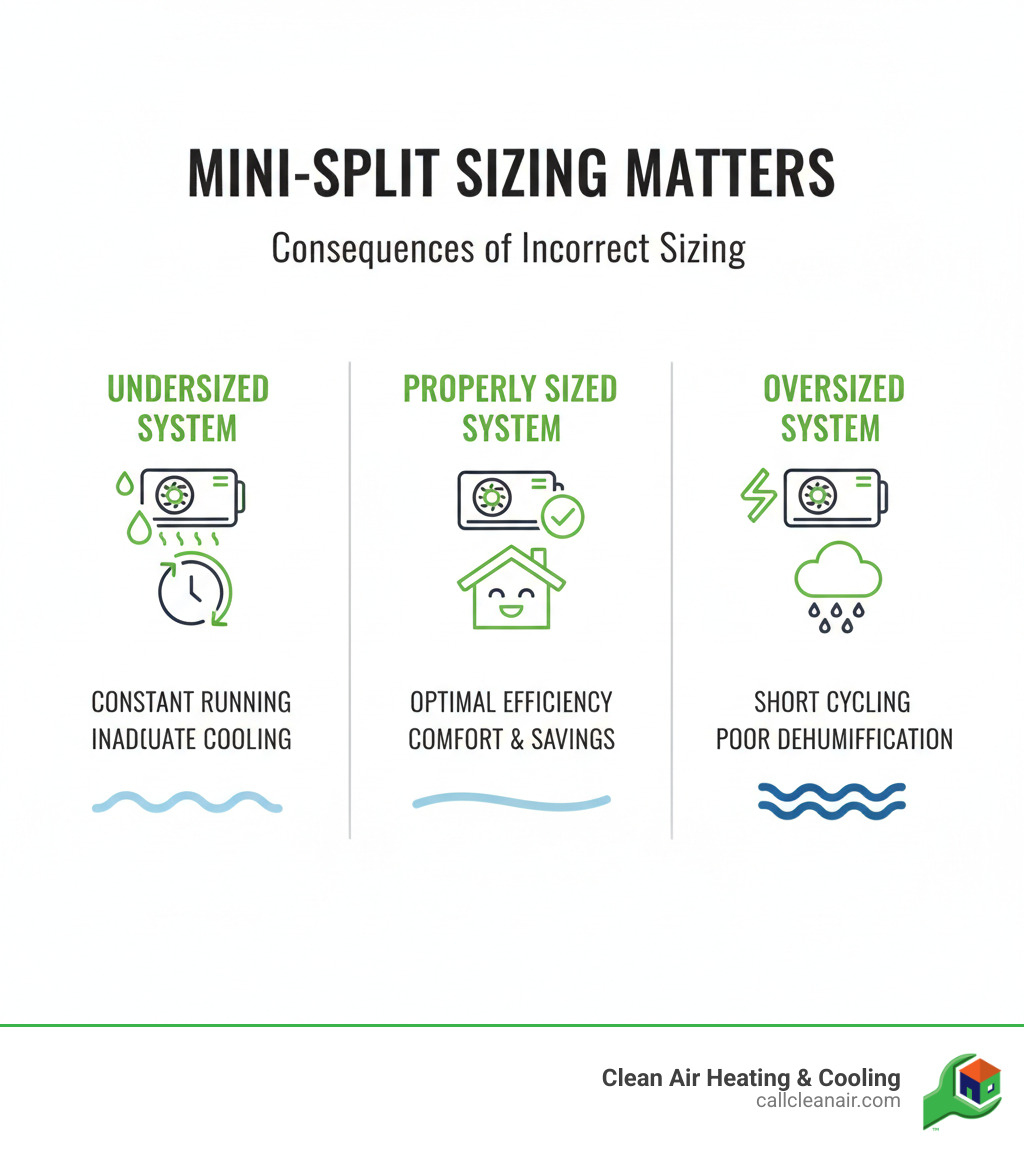
A properly sized mini split runs efficiently and saves money. An undersized system struggles to cool your space, runs constantly, and drives up energy bills. An oversized system is even worse—it short cycles (turns on and off repeatedly), fails to remove humidity, wastes energy, and costs more upfront.
The difference between a comfortable home and an expensive disappointment is getting the size right from the start.
As Colin Matei, Owner of Clean Air Heating & Cooling, I’ve helped hundreds of homeowners across Whatcom, Skagit, and Snohomish Counties get their mini split sizing right. Our team understands the unique heating and cooling challenges of the Pacific Northwest, ensuring optimal comfort and efficiency for our community.
Step 1 & 2: Measure Your Space and Calculate Base BTUs
Getting your mini split sizing right starts with a tape measure and some basic math.
Measuring Your Space
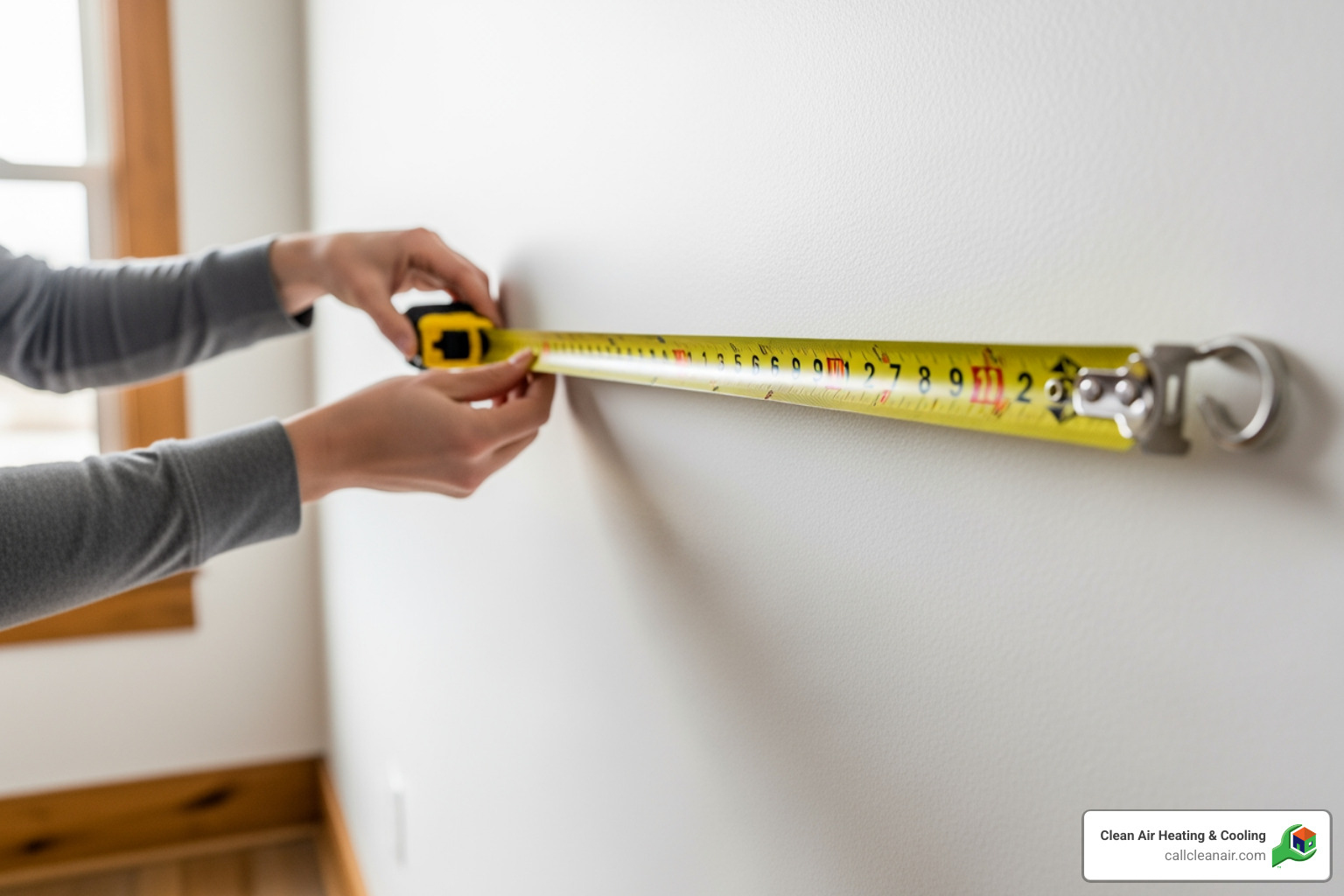
Start by measuring the length and width of your room. For example, if your home office is 15 feet long and 12 feet wide, you multiply those numbers: 15 × 12 = 180 square feet. That’s your room’s square footage. For most rooms, this simple length-times-width calculation works perfectly.
Calculating Your Base BTU Requirement
Once you know your square footage, you can estimate your heating and cooling needs. The general rule is to multiply your square footage by 20 to 25 BTUs. This gives you a baseline before we factor in your space’s unique characteristics.
For our 180 square foot office, the calculation is: 180 sq ft × 25 BTUs/sq ft = 4,500 BTUs. This is the foundation of your mini split sizing calculation, but not the final answer.
| Room Size (Square Feet) | Base BTU Range (20-25 BTU/sq ft) | Typical Mini Split Size |
|---|---|---|
| 100 – 150 | 2,000 – 3,750 | 5,000 – 6,000 BTU |
| 150 – 250 | 3,000 – 6,250 | 6,000 – 9,000 BTU |
| 250 – 350 | 5,000 – 8,750 | 9,000 – 12,000 BTU |
| 350 – 450 | 7,000 – 11,250 | 12,000 – 15,000 BTU |
| 450 – 600 | 9,000 – 15,000 | 15,000 – 18,000 BTU |
You’ll notice the actual mini split sizes are often higher than the base calculation suggests. That’s because manufacturers account for real-world factors—and we’re about to do the same.
Understanding BTUs and Tons
At the core of mini split sizing is the BTU, or British Thermal Unit. One BTU is the energy needed to raise one pound of water by one degree Fahrenheit. It tells you how much heating or cooling power your mini split can deliver per hour.
You might also hear HVAC pros talk about “tons.” One ton equals 12,000 BTUs per hour. It’s just a different way to express capacity, especially for larger systems.
Getting the BTUs right is crucial. As we mentioned, an undersized system runs constantly without providing enough comfort, while an oversized system short cycles, fails to dehumidify, and wastes energy. Proper mini split sizing finds the sweet spot where your system runs efficiently, maintains consistent temperatures, and controls humidity effectively.
Want to understand more about how these systems actually work their magic? Check out our guide on How Do Ductless Mini Split Systems Work?.
Step 3: Refine Your Estimate with Critical Adjustments for Mini Split Sizing
Now that we have our base BTU estimate, it’s time to fine-tune it. Many factors beyond floor space influence your heating and cooling needs, and ignoring them can throw off your mini split sizing calculation.

- Ceiling Height: Standard calculations assume 8-foot ceilings. For every foot above 8 feet, add 12.5% to your base BTU number. A room needing 10,000 BTUs with 10-foot ceilings would require an additional 25% (2 x 12.5%), bringing the total to 12,500 BTUs.
- Insulation Quality: Good insulation keeps conditioned air inside. Older homes in Whatcom County or those with poor insulation lose and gain heat faster. If you know your insulation is lacking, add 20% to your BTU requirement.
- Windows and Sun Exposure: Large windows are thermal weak points. A room with many windows, especially south or west-facing ones that get intense afternoon sun, needs more cooling power. Add 10% for sunny rooms. Conversely, you might reduce your estimate by 10% for a heavily shaded, north-facing room.
- Local Climate: Our Pacific Northwest climate has unique challenges. While we don’t have extreme temperatures, our warm summers and cool, damp winters require a properly sized system. A professional assessment will account for our specific regional weather patterns in Bellingham, Mount Vernon, and Oak Harbor.
- Occupancy: Each person generates about 600 BTUs of body heat. If you’re sizing a system for a family room that regularly holds five people, but your base calculation assumes two, you need to add 1,800 BTUs (600 BTUs x 3 extra people).
- Kitchens: Kitchens are heat factories. Between the oven, cooktop, and refrigerator, they generate significant heat. If you’re conditioning a kitchen, add a solid 4,000 BTUs to your cooling calculation.
These adjustments are what separate a system that works okay from one that works beautifully. Taking the time to account for these factors ensures your mini split will keep you comfortable without wasting energy.
For more detailed guidance on choosing the right capacity for your specific situation, check out our comprehensive guide: What Size Mini Split Do I Need?
Step 4: Sizing for Single-Zone vs. Multi-Zone Systems
Once you’ve calculated your adjusted BTU requirements, you’ll need to decide between a single-zone or multi-zone system.
Single-zone systems are simple: one outdoor compressor is paired with one indoor unit. This is perfect for a single area like a sunroom, garage workshop, or a specific bedroom. The mini split sizing is straightforward: match the indoor unit’s BTU capacity to the room’s adjusted requirement from Step 3. If your office needs 9,000 BTUs, you select a 9,000 BTU single-zone system.
Multi-zone systems use a single outdoor unit to connect to multiple indoor units (or “heads”) throughout your home. Homeowners across Whatcom and Skagit Counties love the flexibility. You might have one head in the primary bedroom, another in the living room, and a third in a guest room, all running off one outdoor compressor.
The beauty of multi-zone mini split sizing is that each indoor unit is sized for its specific room. Your large, sunny living room might need a 12,000 BTU unit, while a small, shaded bedroom only needs 6,000 BTUs. This individual control saves energy by not cooling the entire house when you only need to cool one room.
The outdoor condenser unit must be powerful enough to support the combined load capacity of all indoor units. This is where professional design becomes critical, as it’s rare for every room to demand maximum power at the same time. The system intelligently directs capacity where it’s needed most.
For more guidance on determining how many indoor units your home might need, take a look at our How Many Mini Splits Need Guide.
Advanced mini split sizing for multi-zone systems
Here’s something that surprises many homeowners: your outdoor unit’s capacity doesn’t always have to match the total BTU rating of all your indoor units. It’s common to “oversubscribe” in multi-zone installations.
For example, you could connect four 12,000 BTU indoor units (totaling 48,000 BTUs) to a 36,000 BTU (3-ton) outdoor unit. This works because not all zones run at maximum capacity simultaneously. In the morning, you might cool the kitchen and living areas; at night, you heat the bedrooms. The outdoor unit shifts its capacity where it’s needed.
There is a caveat: if every zone did demand full power at once, the outdoor unit can only deliver its rated capacity, and some zones might cool more slowly. However, in typical daily use, this is rarely an issue.
This is why professional design is so important for multi-zone mini split sizing. A certified HVAC professional understands load calculations and diversity factors. Improper design and installation are the biggest reasons for mini-split problems and can void your manufacturer warranty. Many quality systems, when properly installed, come with an impressive 12-year factory warranty, but only when sized and installed correctly.
At Clean Air Heating & Cooling, we design and install multi-zone systems throughout Bellingham and the surrounding areas, creating systems that keep you comfortable without wasting energy.
Step 5: Finalize Your Plan with a Professional Consultation
You’ve measured your rooms, crunched the numbers, and made adjustments for everything from ceiling height to sunny windows. That’s fantastic! You now have a solid estimate for your mini split sizing. But here’s where I need to be honest with you: even with all that work, you’re still looking at an educated guess—not a guarantee.
This is where bringing in a qualified HVAC professional makes all the difference. Think of it this way: you wouldn’t perform surgery on yourself after watching a few YouTube videos, right? The same principle applies here. Your DIY estimate gets you in the ballpark, but a professional can pinpoint the exact right solution for your home.
A professional will perform what’s called a Manual J load calculation. This is the gold standard in the HVAC industry—a comprehensive assessment that goes far beyond our basic square footage and adjustment factors. They’ll evaluate your home’s actual building materials and their R-values (that’s insulation effectiveness), analyze every window’s U-factor and solar heat gain coefficient, measure how much air leaks in and out of your home, and incorporate precise climate data specific to our region in Whatcom, Skagit, and Snohomish Counties.
Here in the Pacific Northwest, our climate presents unique challenges. We’re not dealing with Phoenix summers or Minnesota winters, but we do have our own quirks—mild, wet winters and increasingly warm summer days. A professional understands these nuances and how they impact your mini split sizing needs. What works perfectly in Bellingham might need slight adjustments for a home in the San Juan Islands or down in Everett.
Beyond the numbers, a professional consultation ensures your system will last. They’ll advise on the best placement for your outdoor condenser unit—ideally in a shaded spot with good airflow. When your condenser sits in direct sunlight all day, it works harder and consumes more energy. It’s like asking someone to run a marathon in a winter coat—technically possible, but unnecessarily difficult.
There’s also the warranty consideration. Most manufacturers, including those offering impressive 12-year factory warranties, require professional installation for the warranty to remain valid. Improper installation and incorrect sizing are the two biggest reasons homeowners run into problems with their mini splits. Don’t let a DIY approach void your protection.
At Clean Air Heating & Cooling, we’ve helped hundreds of homeowners across Bellingham, Mount Vernon, Oak Harbor, and beyond get their mini split sizing exactly right. Our team knows the ins and outs of proper installation, and we’re committed to ensuring your system performs flawlessly from day one. For more guidance on getting your installation right, check out our Mini Split Installation Tips.
The bottom line? Your estimate is a great starting point, but a professional consultation is your finish line. It’s the difference between hoping your system works well and knowing it will.
Frequently Asked Questions about Sizing Your Mini Split
We get a lot of questions about mini split sizing, and for good reason! It’s a critical step that impacts your comfort and wallet. Let me address the most common ones:
Is it better to oversize or undersize a mini split?
The honest truth is that neither option is ideal; proper sizing is always the goal. However, if you must choose, oversizing is generally worse than undersizing.
An oversized system short cycles—it turns on and off too frequently. This prevents it from properly dehumidifying the air, leaving your room feeling cold and clammy. Short cycling also wastes energy and puts significant stress on the compressor, shortening its lifespan.
An undersized system will struggle on extreme weather days, but it runs more consistently. This allows for better humidity removal and less wear and tear compared to an oversized unit. The best solution is to avoid both scenarios by getting your mini split sizing right from the start.
How many BTUs do I need for a 1,000 sq ft space?
Using the base rule of thumb, a 1,000 sq ft space would need 20,000 to 25,000 BTUs. However, a space this large is rarely a good candidate for a single mini split unit.
Unless it’s a completely open-concept layout, you’ll likely need a multi-zone system to condition the area effectively, as air doesn’t travel well through doorways or around corners. Furthermore, the base calculation is just a starting point. Adjustments for ceiling height, insulation, windows, and occupancy are critical for a space this size and will significantly impact your final BTU needs.
A professional load calculation is the only way to determine the total capacity required and how to distribute it effectively across multiple zones. Our Ductless Sizing Chart can offer general guidance for your initial planning.
Can one mini split cool an entire house?
A single indoor unit on one wall cannot cool an entire house. Mini splits operate on a zone-by-zone basis, conditioning the room they are in.
However, one multi-zone system can absolutely cool a whole house. This involves pairing one outdoor unit with multiple indoor units strategically placed in different rooms. For example, you could have units in each bedroom and a larger one in the main living area.
This approach provides whole-home comfort without ductwork, which is ideal for many homes in Whatcom and Skagit Counties. You also gain individual temperature control for each room. The key is professional planning to ensure each zone is sized correctly and the outdoor unit can support the total load.
Conclusion: Get Your Perfect Mini Split Size Guaranteed
You’ve made it through all five steps of mini split sizing: measuring your space, calculating base BTUs, making those crucial adjustments for your home’s unique features, choosing between single-zone and multi-zone configurations, and understanding why a professional’s eye matters so much.
Here’s the honest truth: everything we’ve covered gives you a solid foundation for understanding what your home needs. You can absolutely use these steps to get a ballpark estimate that’s far more accurate than just guessing. But your home is unique—from the way afternoon sun streams through your west-facing windows to how well your insulation performs during those chilly Bellingham winters—and these nuances deserve professional attention.
That’s where we come in. At Clean Air Heating & Cooling, we’ve spent years helping homeowners throughout Whatcom, Skagit, Snohomish, and San Juan Counties find their perfect heating and cooling solutions. We know the Pacific Northwest climate inside and out, from the marine air near the San Juans to the warmer summers inland in Mount Vernon. Our team doesn’t just install equipment—we design comfort systems custom to your specific home and lifestyle.
We stand behind our work with a 25% utility savings guarantee on qualifying systems because we’re confident in what proper mini split sizing and expert installation can achieve. With over 480 five-star Google reviews, we’ve built our reputation on doing things right the first time, every time.
Your DIY estimate is a great starting point, but let’s make it perfect together. A professional load calculation ensures your system will perform exactly as it should—efficiently, reliably, and comfortably—for years to come. Plus, proper professional installation protects your investment and keeps your warranty intact.
Ready to move forward? Start with our free Mini Split Sizing Calculator to get your initial estimate, then reach out to our team. We’ll verify your calculations, answer any questions, and design a system that’s just right for your home. No guesswork, no surprises—just guaranteed comfort.