Furnace Repair Tips: 5 Easy Fixes 2025
Getting Started: Quick Checks for Your Furnace
When your furnace stops working, it can feel like a disaster. Fortunately, many common furnace issues have simple solutions. These furnace repair tips can help you get heat back quickly. Before calling a professional, try these easy checks:
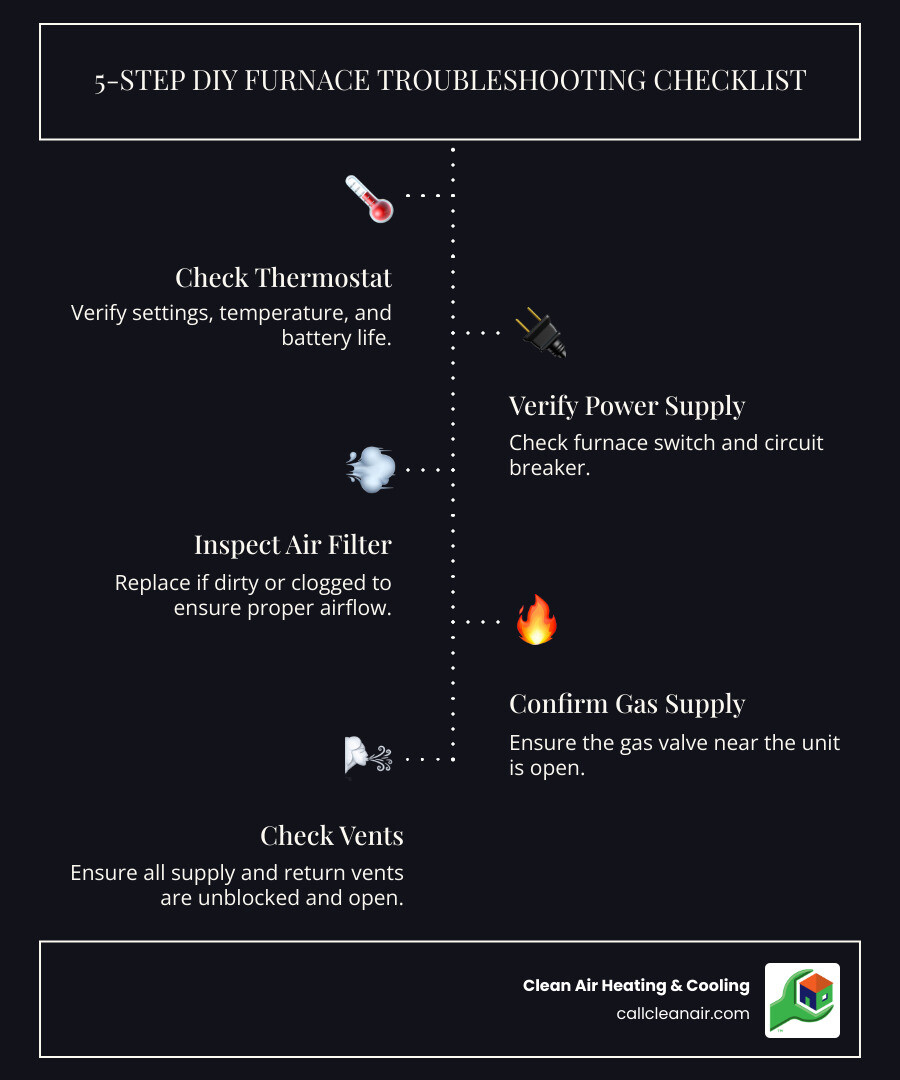
- Check Your Thermostat: Make sure it’s set to “Heat” and the temperature is higher than your home’s current temperature. Replace batteries if it’s a digital model.
- Verify Power Supply: Look for the furnace’s power switch (often on the unit itself) and ensure it’s “On.” Also, check your home’s circuit breaker box and reset any tripped breakers.
- Inspect the Air Filter: A clogged filter is a common culprit. Pull it out and hold it to the light. If you can’t see light through it, replace it.
- Confirm Gas Supply: If you have a gas furnace, ensure the gas valve near the unit is open (handle parallel to the pipe).
- Check Vents: Make sure all supply and return vents are open and not blocked by furniture or debris. Keep at least 80% of your home’s vents open at all times.
A cold house is more than uncomfortable; it can lead to frozen pipes. Learning basic troubleshooting steps can save you time and money on service calls.
As the Owner and President of Clean Air Heating & Cooling, I’m deeply committed to enhancing comfort for our Bellingham, WA community. My experience provides reliable furnace repair tips and solutions, ensuring peace of mind for our valued customers.
For a quick visual guide, check out this infographic:
Basic furnace repair tips vocab:
Safety First: What to Check Before You Start
Before you dive into any furnace repair tips, let’s talk about safety. Your furnace is a powerful appliance that uses electricity and, in many cases, natural gas, so it’s crucial to be careful. These steps are your essential pre-check to keep you and your home safe.
The golden rule is simple: Always turn off the power to your furnace before you do anything beyond a quick glance. This is a must. You’ll usually find two main spots where you can cut the power:
- The Furnace Switch: Look for a light-switch-like toggle right on the furnace unit itself, or sometimes on a nearby wall. It’s easy for this to get accidentally flipped off, perhaps mistaken for a light switch. Make sure it’s firmly in the “On” position to check if that’s the issue. If you’re going to touch anything inside, flip it to “Off” first!
- The Circuit Breaker: Head over to your home’s main electrical panel. This is often in your basement, garage, or a utility closet. Find the circuit breaker labeled for your furnace – it might say “Furnace,” “HVAC,” or “Heater.” If you see a breaker that’s “tripped” (usually sitting halfway between “On” and “Off”), simply push it completely to “Off” and then back to “On” to reset it. If you have an older home with a fuse box, check for a blown fuse, and if found, replace it with an identical one.
For those with gas furnaces, there’s one more important check: make sure the gas supply valve is open. This valve is usually a lever on the gas pipe leading directly to your furnace. For the gas to flow, the handle should be parallel with the pipe. If it’s perpendicular, it’s closed, and you’ll need to turn it parallel to open it.
Crucial Safety Reminders for Your DIY Journey:
Before moving forward with these furnace repair tips, keep these safety precautions in mind:
- Your Owner’s Manual is Your Best Friend: Every furnace is a little different. Always take a moment to consult your furnace’s owner’s manual. It’s packed with specific instructions and warnings just for your model.
- Beware of Electrical Hazards: Electricity and water do not mix! Never touch any electrical components inside your furnace with wet hands, and certainly not if you’re standing in water.
- Know the Signs of a Gas Leak: This is incredibly serious. If you ever smell gas – it’s often described as a rotten egg or sulfur smell – do NOT try to troubleshoot or fix anything. This is an emergency. Evacuate your home immediately, leave the door open, and call your gas company or 911 from a safe distance.
- Carbon Monoxide Detectors are Essential: Carbon monoxide is a colorless, odorless gas, making it impossible to detect without a special device. Make sure you have functioning carbon monoxide detectors near your furnace and on every level of your home. These little devices are truly lifesavers.
Taking these initial safety steps protects you and your loved ones as you bravely tackle these helpful furnace repair tips.
Your DIY Furnace Repair Checklist: Simple Fixes for Common Problems
When your furnace takes an unscheduled break, don’t panic. Many furnace problems have surprisingly simple solutions that don’t require special tools or HVAC training. This step-by-step furnace repair tips guide can help you diagnose and fix common heating issues before calling in the professionals. These troubleshooting steps are designed for the average homeowner, focusing on safe checks that often resolve frequent furnace complaints.

1. Check the Thermostat
Your thermostat is essentially your furnace’s command center, and you’d be amazed how many “broken” furnaces are actually just responding to confused thermostats. This is always our first stop when troubleshooting heating issues.
Start with the thermostat settings – it sounds almost too simple, but make sure it’s set to “Heat” mode and that your desired temperature setting is at least 5 degrees higher than your home’s current temperature. We’ve seen countless service calls that could have been avoided with this quick check!
If you have a digital thermostat, dead batteries are often the culprit behind mysterious heating failures. Even if the display looks fine, weak batteries can cause erratic behavior. Replace them with fresh ones – it’s a two-minute fix that solves more problems than you might expect.
For smart thermostat users, connection issues can sometimes disrupt normal operation. Check that your thermostat is properly connected to your home’s Wi-Fi network, especially if you’ve recently changed your internet password or had connectivity issues.
2. Inspect and Replace the Furnace Filter
Here’s one of the most important furnace repair tips we can share: a clogged filter causes more furnace problems than almost any other single issue. Think of it like trying to breathe through a dirty cloth – your furnace struggles just as much when its filter is packed with dust and debris.
The restricted airflow from a dirty filter forces your furnace to work harder, reduces heating efficiency, and can even cause the system to overheat and shut down as a safety measure.
How to locate the filter: Your furnace filter typically lives in the return air duct, either inside the furnace unit itself or in a separate filter cabinet nearby. Look for a rectangular slot where the filter slides in and out.
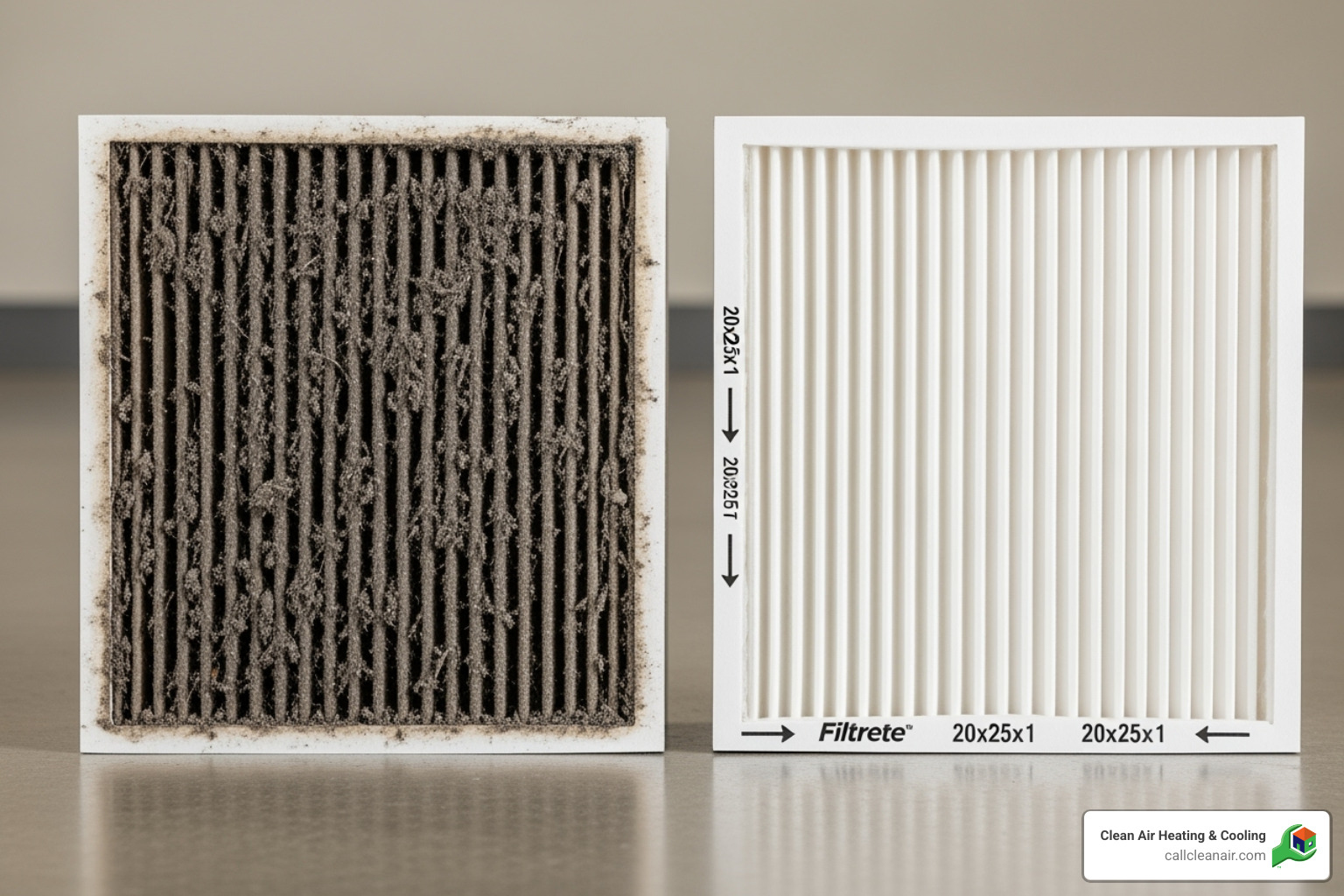
How to replace the filter: First, turn off your furnace for safety. Pull out the old filter and hold it up to a light source. If you can’t see light passing through easily, or if it looks like it’s been collecting dust for months, it’s time for a replacement. When installing the new filter, pay attention to the directional arrows – they should point toward the furnace, following the airflow direction.
Replacement frequency varies depending on your home’s conditions, but we recommend checking monthly during heating season. Generally, filters need changing every 1-3 months, though homes with pets, allergies, or high dust levels may need more frequent changes. For comprehensive guidance on keeping your system running smoothly, check out our Furnace Maintenance Checklist.
3. Verify the Power Supply
Sometimes the most effective solutions are the simplest ones. Your furnace needs consistent electrical power to operate, and power interruptions are more common than you might think.
Start by checking the furnace power switch – this dedicated switch is usually located directly on the furnace unit or on a nearby wall. It often looks just like a regular light switch, and occasionally gets turned off by mistake. Make sure it’s firmly in the “On” position.
Next, head to your electrical panel to check for a tripped circuit breaker. Look for the breaker labeled “Furnace,” “HVAC,” or “Heater.” A tripped breaker will be in the “Off” position or sitting halfway between “On” and “Off.” How to reset the breaker: Push it completely to “Off” first, then flip it back to “On.” You should hear a definitive click when it engages properly.
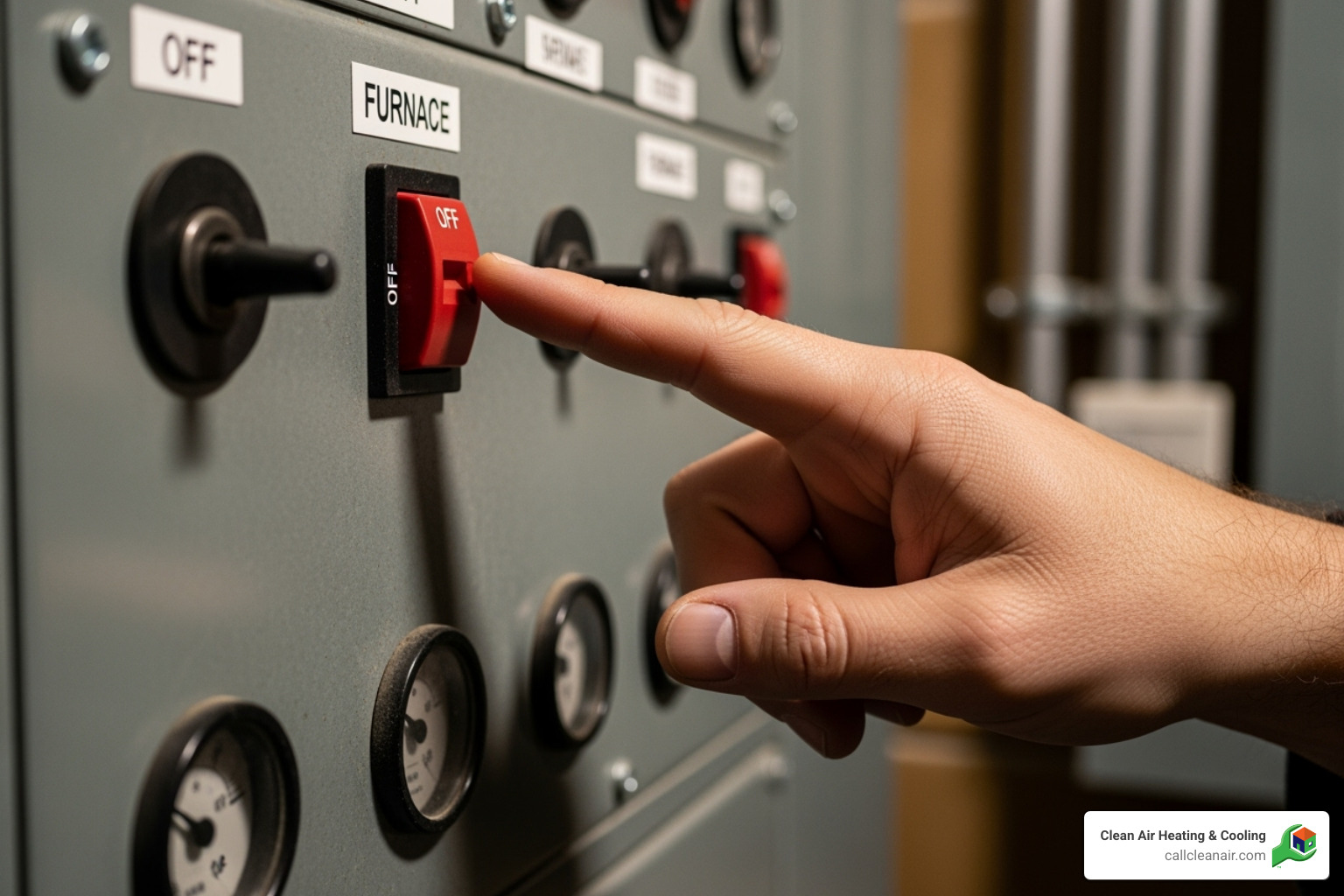
If you have an older home with a fuse box instead of circuit breakers, look for a blown fuse. A blown fuse will appear melted, discolored, or have a broken filament visible through the glass. Replace it with a new fuse of exactly the same amperage.
If a breaker trips immediately after you reset it, or if fuses keep blowing, there’s likely a more serious electrical issue that requires professional attention.
4. Ensure Air Vents Are Open and Clear
Proper airflow is like the circulatory system of your heating setup – when it’s restricted, everything suffers. Blocked vents and closed registers can create pressure imbalances that force your furnace to work harder and may even cause it to overheat.
Take a walk through your home and check both supply vents (where warm air comes out) and return vents (where cool air gets pulled back to the furnace). Look for furniture obstruction – couches pushed against vents, rugs covering floor registers, or toys that have found their way into ductwork openings.
Here’s a common misconception we encounter: many homeowners think closing vents in unused rooms saves energy. In reality, this often backfires. Most residential HVAC systems are designed to work with consistent airflow throughout the home. We recommend following the 80% open rule – keep at least 80% of your home’s vents open at all times to maintain proper system balance.
For more detailed guidance on optimizing your heating system’s performance, explore our Furnace Troubleshooting Tips.
5. Check the Gas Supply and Pilot Light
If you have a gas furnace, ensuring proper gas flow and ignition is crucial for operation. Start by locating the main gas valve near your furnace – the handle should be parallel to the gas pipe when open. If it’s perpendicular to the pipe, turn it so it runs parallel.
For older furnaces with a pilot light, check if it’s still burning. A healthy pilot flame should be mostly blue with perhaps a small yellow tip. If the pilot light is out, you’ll need to relight it following your owner’s manual’s specific instructions. Generally, this involves turning off the gas for 10-15 minutes to let any residual gas dissipate, then following the relighting procedure, which typically requires holding down a button while lighting the pilot.
Most modern furnaces use electronic ignition systems instead of standing pilot lights. These systems use either a hot surface igniter (which glows like a light bulb filament) or an intermittent pilot system. If your furnace cycles but doesn’t ignite, you might hear clicking sounds from the igniter attempting to create a spark, or see a glowing element trying to heat up.
The flame sensor is a critical safety component – it’s a small metal rod that detects whether a flame is present. If it doesn’t sense a flame within about seven seconds of gas flow starting, it automatically shuts off the gas supply. A dirty flame sensor can cause your furnace to start up and then quickly shut down repeatedly. While you can sometimes gently clean it with fine sandpaper, make sure the power is completely off first.
Gas-related issues can become dangerous quickly. If you smell gas at any point, or if these basic checks don’t resolve the ignition problem, it’s definitely time to call in professional help.
When to Call a Pro: Signs Your Furnace Needs Expert Help
While these DIY furnace repair tips can solve many common issues, some problems are best left to the professionals. Certain furnace issues require an expert’s touch. Knowing when to call a professional HVAC technician from Clean Air Heating & Cooling can prevent further damage, ensure your safety, and save you money. If you encounter complex problems, safety risks, or symptoms that persist after basic troubleshooting, it’s time for a professional diagnosis. For more guidance on recognizing these warning signs, check out our detailed guide on Signs My HVAC System Needs Repair.
Essential furnace repair tips for strange noises and smells
Your furnace is like a friend who’s trying to tell you something’s wrong – it communicates through sounds and smells. Learning to interpret these signals can help you determine when professional help is needed.
Banging or popping sounds during startup often indicate dirty burners causing delayed ignition. This creates a small gas buildup that ignites with a mini explosion. While not always immediately dangerous, it signals your furnace needs professional cleaning to prevent further issues.
Squealing or grinding noises typically mean metal components are wearing out. The high-pitched squealing usually points to blower motor bearings that need lubrication or replacement. Grinding sounds are more serious and often indicate damaged parts rubbing against each other.
Rattling sounds commonly occur when components become loose – things like blower motor parts, trapped debris, or loose screws and panels. Sometimes it’s as simple as tightening a few screws, but persistent rattling can indicate failing internal parts.
When it comes to smells, your nose is your best safety tool. A rotten egg smell is the most critical warning sign you’ll encounter. Natural gas companies add this distinctive odor so you can detect leaks. If you smell this sulfur-like scent, don’t attempt any furnace repair tips – evacuate immediately and call your gas company or 911 from outside your home.
Burning plastic or electrical smells signal overheating components or melting wires. These odors require immediate attention – turn off your furnace and call a professional right away. The dusty smell when you first fire up your furnace each season is normal and should disappear within a few hours.
For comprehensive information about how home heating systems work and their safety features, the U.S. Department of Energy provides excellent resources: More about home heating systems from the U.S. Department of Energy.
Advanced furnace repair tips for major symptoms
Beyond strange noises and smells, certain major symptoms clearly indicate your furnace needs professional intervention. These issues go beyond simple DIY solutions and require expert diagnosis and repair.
Furnace short cycling is when your system turns on for less than the normal 10-15 minute heating cycle, shuts off, then quickly turns back on again. While a dirty filter or blocked vents might cause this, persistent short cycling often indicates oversized equipment, thermostat malfunctions, or safety features responding to overheating or component failures.
Blowing cold air when your furnace is running is definitely abnormal. This frustrating problem can stem from gas supply issues, overheating that triggers safety shutdowns, dirty flame sensors, or even leaky ductwork that’s allowing heated air to escape before reaching your living spaces.
A furnace that won’t turn off and runs constantly, even after reaching the set temperature, typically indicates thermostat problems or control board failures. While some single-stage furnaces run longer to maintain temperature, continuous operation without cycling off signals a malfunction.
Water pooling around your furnace, especially with high-efficiency models, often means clogged condensate drain lines. These lines remove acidic water produced during combustion, and blockages can cause water backup and potential damage to your system and surrounding areas.
Overheating issues, indicated by frequent safety shutdowns or error codes, occur when limit switches trip to protect your furnace. This can result from restricted airflow, failing blower motors, or heat exchanger problems. Repeated overheating episodes can cause significant damage and require immediate professional attention.
If you’re dealing with an older furnace and facing increasing repair costs, it might be time to consider replacement. Our guide can help you make this important decision: Should I Repair or Replace My Old HVAC System?
Common Homeowner Mistakes to Avoid
Even with the best intentions, homeowners sometimes make mistakes that can actually make furnace problems worse or create new issues. Avoiding these common pitfalls will help keep your system running smoothly and safely.
- Closing too many vents to “save energy” in unused rooms actually creates pressure imbalances that make your blower motor work harder and can damage your ductwork
- Skipping annual maintenance leads to small problems becoming expensive repairs and often voids manufacturer warranties
- Ignoring warning signs like strange noises or smells allows minor issues to develop into major breakdowns
- Attempting dangerous repairs involving gas lines, complex electrical work, or internal combustion components without proper training and tools
There’s no shame in calling professionals when furnace repair tips reach their limits. The goal is keeping your family warm and safe, and sometimes that means knowing when to step back and let the experts handle the situation.
Frequently Asked Questions about Furnace Repair
When your furnace acts up, you probably have questions. We hear from homeowners across Whatcom, Skagit, Snohomish, and San Juan Counties daily, and these are their most common concerns.
Why is my furnace blowing cold air?
If your furnace is running but blowing cold air, don’t panic. There are several common explanations.
The first thing to check is your thermostat fan setting. If it’s set to “On” instead of “Auto,” your fan runs continuously, even when the furnace isn’t actively heating. This means you’ll feel room-temperature air circulating, which feels cold compared to heated air. Simply switch it to “Auto” and see if that solves the problem.
Your furnace might also be overheated. When this happens, safety features kick in and shut down the burners while the fan keeps running to cool things down. This overheating often stems from a clogged filter that’s blocking proper airflow, closed vents, or a malfunctioning blower motor.
A dirty flame sensor can also cause this issue. This small safety device tells your furnace whether there’s actually a flame burning. When it gets dirty, it can’t “see” the flame properly and shuts off the gas supply as a precaution. The fan continues running, but there’s no heat being produced.
Finally, check for gas supply issues. If your gas valve is closed or your pilot light is out (on older furnaces), the burners simply won’t ignite. Your furnace will try to do its job, but it can only circulate unheated air.
How often should I schedule professional furnace maintenance?
One of the best furnace repair tips we can give is to schedule professional maintenance annually, preferably in the fall. Think of it as a yearly physical for your heating system that keeps it running smoothly and catches problems before they become emergencies.
This annual maintenance brings incredible efficiency benefits. A well-tuned furnace uses less energy to heat your home, which means lower utility bills. Our customers love seeing those savings, especially with our 25% utility savings guarantee!
More importantly, professional maintenance includes a thorough safety inspection. Our technicians check for gas leaks, inspect your heat exchanger for cracks that could leak carbon monoxide, and ensure all safety systems are working properly. These aren’t things you can easily check yourself, but they’re crucial for your family’s safety.
Regular tune-ups also extend your furnace’s lifespan significantly – sometimes by 10% or more. That means delaying the expense of a replacement system for years. Plus, many manufacturers require annual servicing to keep your warranty valid, so skipping maintenance could cost you if something major goes wrong.
The best part? Catching small issues during routine maintenance prevents those dreaded middle-of-winter breakdowns when you need heat the most. For more seasonal tips, check out our Heating Maintenance Tips.
What does it mean if my furnace keeps turning on and off?
This annoying problem is called short cycling, and it means your furnace isn’t completing its normal heating cycle of 10-15 minutes. Instead, it starts up, runs briefly, shuts off, then repeats the process over and over.
The most common culprit? A clogged air filter. When your filter is dirty, it restricts airflow so severely that your furnace overheats quickly. Safety switches kick in and shut everything down to prevent damage. Once things cool off a bit, the cycle starts all over again.
Incorrect thermostat placement can also cause short cycling. If your thermostat sits in direct sunlight, near a heat register, or close to another heat source like a lamp, it gets a false reading of your home’s temperature. It thinks your house is warmer than it actually is, so it shuts off the furnace prematurely.
Sometimes the problem is an oversized furnace that’s simply too powerful for your home. It heats your space so quickly that it reaches the thermostat setting before properly distributing heat throughout your house. This leads to frequent on-off cycles that waste energy and create uneven temperatures.
The overheating safety switch can trip for various reasons beyond a dirty filter – a failing blower motor, blocked ductwork, or a malfunctioning limit switch. While replacing a dirty filter is straightforward, persistent short cycling usually needs professional diagnosis to identify and fix the root cause.
Conclusion: Keep Your Home Warm and Efficient
When your furnace stops working on a cold night, it doesn’t have to be a disaster. The furnace repair tips we’ve covered can often get your heat running again without an expensive service call. Simple checks of the thermostat, filter, and power supply can solve many common heating problems.
Safety always comes first. Turn off the power before inspecting your furnace, watch for signs of gas leaks, and don’t hesitate to call professionals when you’re unsure. Some problems – like strange burning smells, persistent unusual noises, or furnaces that won’t stop short cycling – require expert diagnosis and repair.
The real secret to avoiding furnace emergencies is annual professional maintenance. Think of it as a yearly physical for your heating system. Regular maintenance catches small issues before they become big problems, keeps your energy bills lower, and ensures your furnace will reliably heat your home for years to come. Plus, it often maintains your manufacturer’s warranty protection.
Living in Bellingham, WA, we know how important a reliable heating system is during our Pacific Northwest winters. A well-maintained furnace doesn’t just keep you comfortable – it improves energy efficiency and gives you peace of mind knowing your family will stay warm all season long.
If you’ve worked through these furnace repair tips and your system still isn’t cooperating, it’s time to bring in the experts. At Clean Air Heating & Cooling, we’ve helped hundreds of families across Whatcom, Skagit, Snohomish, and San Juan Counties get their heat back quickly and efficiently. Our 480+ five-star Google reviews reflect our commitment to getting the job done right the first time.
Don’t let a furnace problem leave you in the cold. Contact us for professional heating services and let our experienced team restore comfort to your home!