Understanding Your Water Heater’s Safety Valve
Hot water heater mixing valve adjustment is a simple process that can solve frustrating temperature problems and make your home safer. If you’ve ever been met with a cold shock or a scalding blast in the shower, adjusting your thermostatic mixing valve (TMV) is likely the solution.
Quick Answer: How to Adjust Your Mixing Valve
- Test current temperature – Run hot water at a faucet and measure with a thermometer
- Locate the TMV – Find it near your water heater (on the hot water outlet)
- Remove the cap – Take off the protective cover to access the adjustment dial
- Make small adjustments – Turn ⅛ to ¼ turn at a time (right for cooler, left for hotter)
- Wait and test – Allow water to stabilize for 1 minute, then measure again
- Target temperature – Aim for 120°F at your faucets for safety and comfort
A TMV blends hot water from your tank with cold water to deliver a safe, consistent temperature throughout your home. It’s your first line of defense against scalding injuries, which is especially important if you have young children or elderly family members. A TMV also increases your usable hot water supply and helps your system run more efficiently.
The key is balance. Your water heater should store water at a high temperature (140°F) to kill harmful bacteria like Legionella, while the mixing valve brings that temperature down to a safe 120°F before it reaches your faucets. When this balance is off, you experience those uncomfortable temperature swings.
As Colin Matei, owner of Clean Air Heating & Cooling, I’ve helped countless Bellingham homeowners solve their hot water problems through proper TMV adjustment. Our team has seen how this simple fix can transform daily comfort and safety.

What is a Thermostatic Mixing Valve and Why is it Important?
A thermostatic mixing valve (TMV)—sometimes called a tempering valve—is the safety guard for your home’s hot water. It acts as a smart blender, constantly mixing hot water from your tank with cold water to deliver a safe, consistent temperature at every tap. Its ability to automatically adjust to pressure and temperature fluctuations is what prevents jarring temperature swings in the shower.
Here’s why a TMV is so critical for your home:
Anti-scald protection is its most important job. Water in your tank can reach 140°F or higher, hot enough to cause severe burns in seconds. A properly set TMV tempers the water to a safe 120°F, dramatically reducing burn risk. The danger is real: at 140°F, a serious burn can occur in less than 5 seconds. At a safer 120°F, that time extends to over 5 minutes, providing a crucial safety buffer.
| Temperature (°F) | Time to Acquire Serious Burn |
|---|---|
| 120 | More than 5 minutes |
| 125 | 1-1/2 to 2 minutes |
| 130 | About 30 seconds |
| 140 | Less than 5 seconds |
| 150 | About 1-1/2 seconds |
| 160 | 1/2 second |
| 155 | 1 second |
| 148 | 2 seconds |
| 140 | 5 seconds |
| 133 | 15 seconds |
| 127 | 1 minute |
| 124 | 3-4 minutes |

Data sourced from Hennepin Healthcare Burn Center and ASSE Plumbing.
Legionella prevention is a hidden benefit. Legionella bacteria, which can cause a severe type of pneumonia, thrives in water between 77°F and 113°F. Storing water at 140°F or higher kills these bacteria. A TMV allows you to maintain this high, safe tank temperature while delivering water at a comfortable 120°F to your faucets. You get both bacterial safety and burn prevention.
Increased hot water capacity and energy efficiency go hand-in-hand. By storing water at 140°F, you use less of it for any given task because it’s being mixed with cold water. This effectively stretches your hot water supply—often by up to 25%—and means your water heater doesn’t need to fire up as often, which can save energy. For a deeper dive, see our water heater experts complete guide.
The Balance Between Water Heater Settings and TMV Output
Proper hot water heater mixing valve adjustment requires balancing two temperatures: the tank setting and the tap output.
Your water heater’s thermostat should be set to 140°F to kill bacteria and maximize capacity. However, this temperature can cause a serious burn in under 5 seconds. The TMV’s job is to temper this down to a safe 120°F, a setting recommended by the EPA for safety and efficiency. This system provides the best of both worlds: safe storage and safe delivery.
While some people prefer hotter showers, the 120°F recommendation is based on burn prevention data. For homes with children or elderly family members, whose skin is more sensitive, we often recommend an even lower output of 105-110°F for an extra layer of protection.
A Step-by-Step Guide to Hot Water Heater Mixing Valve Adjustment
Now that you understand why your TMV is important, let’s walk through the hot water heater mixing valve adjustment process. While many homeowners can do this, it requires patience and attention to safety.

Before you start, gather a reliable digital thermometer, an Allen key or flathead screwdriver (depending on your valve), and protective gloves.
Safety First: Hot water can cause serious burns. Wear protective gloves and be aware that the pipes will be hot. For added safety, consider shutting off the water supply to the heater. If a valve seems stuck or you feel uncomfortable, stop and call a professional.
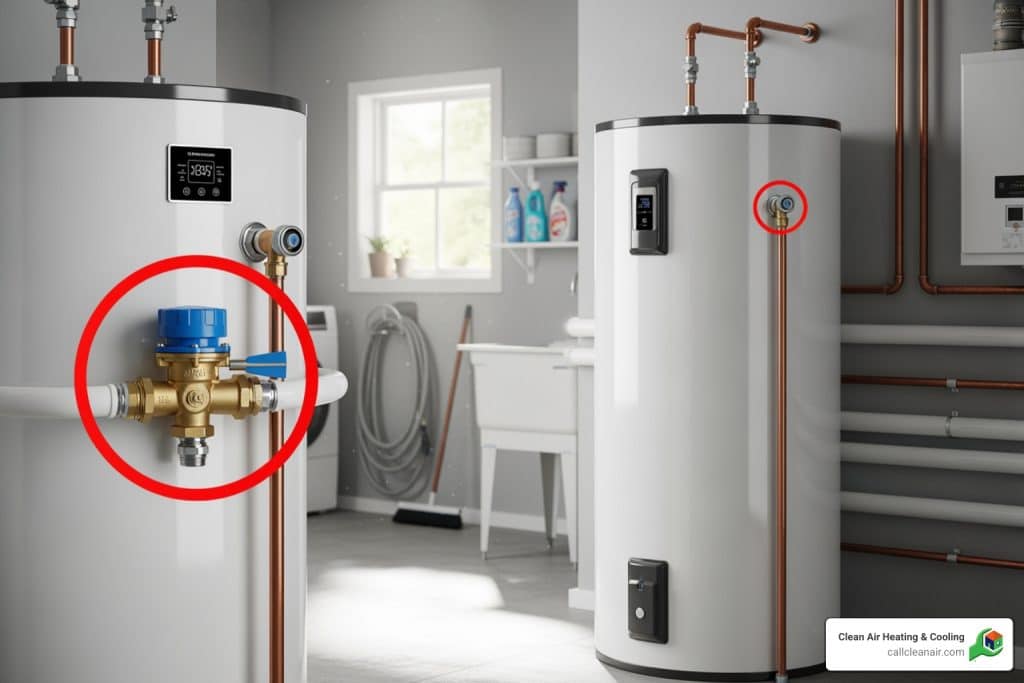
Your TMV is a brass component located on the hot water outlet pipe near your water heater. It has three connections: hot in, cold in, and mixed out.
Step 1: Test Your Current Water Temperature
First, you need a baseline measurement. Go to the faucet farthest from your water heater, as this location gives the most accurate reading of what your household experiences.
Turn the hot water on full and let it run for a minute or two until the temperature stabilizes. Place your thermometer in the stream for 30 seconds to get an accurate reading. Write this number down. If it’s above 120°F, it’s a scalding risk. If it’s too low, you’re likely sacrificing comfort.
Step 2: The Hot Water Heater Mixing Valve Adjustment Process
Return to your water heater and find the TMV.

Most valves have a protective cap that screws or pops off. Remove it to access the adjustment dial or screw. You may need an Allen key, a screwdriver, or you might be able to turn it by hand.
The golden rule is to make small adjustments only—about ⅛ to ¼ of a turn at a time. TMVs are sensitive, and a small turn has a big effect.
- To make water cooler: Turn the dial clockwise (right).
- To make water hotter: Turn the dial counter-clockwise (left).
Always check your valve’s manual if possible, as some models may differ.
Step 3: Verify and Finalize the Temperature
Patience is key. After an adjustment, let the water run for at least a full minute to allow the system to stabilize.
Go back to the same faucet and re-test the temperature. Are you closer to the 120°F target?

If you’re not there yet, repeat the process: make another small adjustment, wait, and test again. It may take a few tries to get it perfect. Once you hit your target temperature, replace the protective cap to prevent accidental changes. It’s also a good idea to test a few other faucets to ensure the temperature is consistent throughout your home.
Troubleshooting and Maintaining Your Mixing Valve
Even with a perfect hot water heater mixing valve adjustment, issues can arise. Your TMV works hard, and over time, mineral buildup and wear can cause problems. Here are some common signs that your TMV needs attention:
- Temperature fluctuations: If your shower water cycles between hot and cold, the valve’s internal thermostatic element may be worn or clogged.
- Weak water flow: A drop in hot water pressure, while cold water flows normally, often points to a blockage from sediment or scale inside the TMV.
- No temperature change: If adjusting the dial does nothing, the valve’s mechanism has likely seized or failed completely.
- Leaks or drips: Water leaking from the valve body indicates worn-out seals or gaskets that need to be replaced.
If you’re facing these issues, our water heater repair complete guide offers more insight into your system.
Recommended TMV Maintenance
To keep your mixing valve working correctly, some periodic attention is needed. The biggest threat is mineral buildup, especially in areas with hard water like Whatcom and Skagit counties. Over time, these deposits can cause the valve to become sluggish or fail.
It’s important to know that the typical lifespan of a mixing valve is only 5-6 years. After years of constant exposure to high temperatures and minerals, the internal components wear out. Signs of failure include delivering only hot or cold water, an adjustment dial that feels loose, or the inability to set a stable temperature.
While professional cleaning is the best way to remove internal buildup, you can help by flushing your water heater annually to reduce sediment. This principle is similar to the advice in our annual boiler maintenance guide.
When to Call a Professional for Hot Water Heater Mixing Valve Adjustment
While adjusting a TMV can be a DIY task, certain situations require an expert. Call a professional if you encounter any of the following:
- Complex issues: Problems like temperature swings combined with pressure drops may indicate a deeper issue than a simple adjustment can fix.
- No change after adjustment: If the temperature won’t change, the valve may be seized or the problem could be with your water heater’s thermostat.
- Pressure drops: A significant drop in hot water pressure after an adjustment suggests an internal blockage or damage.
- You’re unsure or uncomfortable: If you’re not confident in performing the adjustment, it’s always safer to call for help. A mistake could lead to damage or injury.
If your water is dangerously hot despite adjustments, call immediately. For routine inspections and peace of mind, consider scheduling an hvac system checkup with our team.
Frequently Asked Questions about Mixing Valves
As HVAC experts in Whatcom and Skagit counties, we get a lot of questions about thermostatic mixing valves. Here are answers to the most common ones.
What is the ideal temperature for my water heater and mixing valve?
The ideal setup is a water heater tank set to 140°F and a mixing valve output of 120°F. The 140°F tank temperature is hot enough to kill harmful bacteria like Legionella and maximizes your hot water supply. The mixing valve then reduces that temperature to a much safer 120°F for your faucets and showers, preventing scalds. Simply setting the tank to 120°F would create a potential breeding ground for bacteria.
How does a mixing valve contribute to energy efficiency?
It might seem like storing water hotter uses more energy, but a TMV can improve efficiency. By storing water at 140°F and mixing it down, you use less hot water from the tank for any given task. For example, filling a tub requires less water from a 140°F tank than from a 120°F tank. This extends your hot water supply and forces the heater to run less frequently, which saves energy over time. Our HVAC energy saving tips offer more ways to reduce utility costs.
Are there different types of TMVs?
Yes, there are two main types: whole-house valves and point-of-use valves. A whole-house valve is installed at the water heater and protects every fixture in your home. A point-of-use valve is installed at a single fixture, like a specific shower. For residential use, we typically recommend a whole-house valve.
While the function is the same, the hot water heater mixing valve adjustment procedure can vary by brand. Some have hand-turn dials, while others need a tool. Always check the manufacturer’s instructions if you have them. If not, the general steps outlined in this article apply to most models.
Conclusion: Perfect Temperature and Peace of Mind
Getting your hot water temperature right is about more than just comfort—it’s about safety and efficiency. A properly adjusted thermostatic mixing valve protects your family from dangerous scalds, prevents bacterial growth in your tank, and even extends your hot water supply.
Hot water heater mixing valve adjustment is a task many homeowners can handle with patience and the right tools. However, if you run into problems, or simply want the assurance of professional service, there’s no shame in calling an expert.
Living in Northwest Washington, we at Clean Air Heating & Cooling understand the challenges our local water and climate present. We’ve helped hundreds of families in Whatcom, Skagit, Snohomish, and San Juan Counties solve their hot water issues, from simple adjustments to full system diagnostics.
Our team is committed to doing the job right the first time, a promise backed by over 480 5-star Google reviews and our 25% utility savings guarantee. Don’t let an improperly set valve compromise your home’s safety and comfort. Schedule your water heater service today, and let us ensure your system is working perfectly.