Sealing Heating Ducts: 3 Smart Ways to Save
Why Your Leaky Ducts Are Costing You More Than Money
Sealing heating ducts is the process of closing gaps, cracks, and holes in your home’s ductwork to prevent conditioned air from escaping into unconditioned spaces like attics, crawlspaces, or walls. Here’s what you need to know:
- The Problem: In a typical house, 20-30% of heated or cooled air is lost through leaky ducts before it reaches your rooms
- The Solution: Seal ducts using mastic sealant, UL-rated foil tape, or professional technologies like Aeroseal
- The Payoff: Improved comfort, lower energy bills (up to 20% efficiency gain), better indoor air quality, and a longer-lasting HVAC system
- DIY or Pro?: Simple accessible leaks can be DIY projects, but hidden leaks and comprehensive sealing require professional help
If you’ve noticed rooms that never quite feel comfortable, utility bills that seem too high, or an HVAC system that runs constantly but can’t keep up, your ducts are likely the culprit. Those invisible leaks aren’t just wasting the hot air you’re paying to create—they’re also pulling in dust, allergens, and pollutants from spaces you’d never want to breathe. Every dollar you spend heating your home should warm your family, not your crawlspace.
The good news? Sealing your heating ducts is one of the most cost-effective home improvements you can make. Whether you tackle accessible sections yourself or bring in professionals for a comprehensive seal, you’ll see results in both comfort and savings almost immediately.
I’m Colin Matei, owner of Clean Air Heating & Cooling, and over the years I’ve seen countless homes transformed by proper duct sealing. From simple DIY fixes to advanced Aeroseal applications, sealing heating ducts has consistently proven to be one of the smartest investments our Bellingham-area customers make for their homes.

When we talk about your home’s heating and cooling system, the ductwork is often the unsung hero—or the silent saboteur. Your furnace or heat pump works hard to warm or cool the air, but if that air escapes through leaks before it reaches your living spaces, you’re essentially throwing money out the window. In a typical house, anywhere from 20 to 30 percent of the air that moves through the duct system is lost due to leaks, holes, and poorly connected ducts. This isn’t just a minor inefficiency; it’s a significant drain on your wallet and your HVAC system’s lifespan.
This constant air loss forces your HVAC system to work overtime, straining its components and leading to premature wear and tear. A system that has to compensate for leaky ducts will run longer and harder, consuming more energy and driving up your utility bills. Leaky ducts can reduce heating and cooling system efficiency by as much as 20 percent, translating directly into higher energy costs. For valuable insights on how to keep your heating and cooling system running smoothly and efficiently, check out our guide on HVAC Energy Savings.
Beyond the financial impact, leaky ducts wreak havoc on your home’s comfort and indoor air quality. Conditioned air escaping means inconsistent temperatures throughout your home—one room might be toasty warm while another remains stubbornly chilly. This creates those frustrating hot and cold spots that make your home feel less comfortable. What’s more, leaky ducts can pull in unconditioned, dirty air from attics, crawlspaces, and wall cavities, bringing with it dust, allergens, mold spores, and even harmful chemicals. This infiltration compromises your Improve Indoor Air Quality efforts, potentially aggravating allergies and respiratory issues for your family.
Telltale Signs of Leaky Heating Ducts
So, how do you know if your home is suffering from leaky ducts? The signs are often subtle at first, but they become more pronounced over time. Keeping an eye out for these indicators can help us address the problem before it escalates.
Here are the common signs we look for that suggest your heating ducts need attention:
- High Utility Bills: This is often the first and most obvious sign. If your energy bills are consistently higher than those of your neighbors, or if they’ve been steadily climbing without a change in usage, leaky ducts could be a major contributing factor. You’re paying to heat air that never reaches its intended destination.
- Uneven Heating and Cooling: Do some rooms in your home feel significantly warmer or colder than others, even when the thermostat is set to a comfortable temperature? This is a classic symptom of leaky ducts, as conditioned air isn’t being distributed evenly throughout your home.
- Excessively Dusty Home: If you find yourself dusting more frequently than usual, or if there’s a constant film of dust on surfaces shortly after cleaning, leaky return ducts might be drawing dust and debris from unconditioned spaces into your living areas.
- Stuffy or Uncomfortable Rooms: Beyond temperature imbalances, leaky ducts can lead to stale or stuffy air. When ducts leak, your HVAC system struggles to maintain proper airflow and ventilation, leading to poor air circulation and a general feeling of discomfort.
- Backdrafting Risk: This is a serious safety concern. Leaky return ducts can create negative pressure in your home, which can cause combustion gases from appliances like furnaces, water heaters, and clothes dryers to be drawn back into your living space instead of venting outdoors. This phenomenon, known as backdrafting, can introduce dangerous carbon monoxide into your home. The EPA’s Duct Sealing Fact Sheet emphasizes the safety benefits of proper duct sealing.
- Visible Gaps or Holes: While many leaks are hidden, some are visible. Take a look at accessible ductwork in your attic, crawlspace, or basement. Do you see gaps at joints, torn insulation, or disconnected sections? These are clear indicators of air loss.
- Noises from Ducts: Whistling or rattling noises coming from your ductwork can sometimes indicate air escaping or loose connections.
A Homeowner’s Guide to Sealing Heating Ducts: Methods & Materials
Now that we understand why sealing heating ducts is so important, let’s explore the different methods and materials available. Whether you’re comfortable tackling home projects yourself or prefer to leave it to the professionals, there’s a solution that fits your situation. The right approach depends on where your ducts are located, how severe the leaks are, and what level of permanence you’re looking for.
The world of duct sealing basically breaks down into two categories: manual sealing methods, where you apply sealants or tapes directly to the problem areas, and advanced sealing technology, which uses innovative techniques to seal your ducts from the inside out. Each approach has its place, and sometimes the best solution combines both.
For manual sealing, material selection is everything. You need products that can withstand years of temperature swings, vibration, and the constant movement of air. And for advanced solutions like Aeroseal, you’re looking at cutting-edge technology that can reach leaks you never even knew existed.
Manual Sealing: Mastic vs. Foil Tape
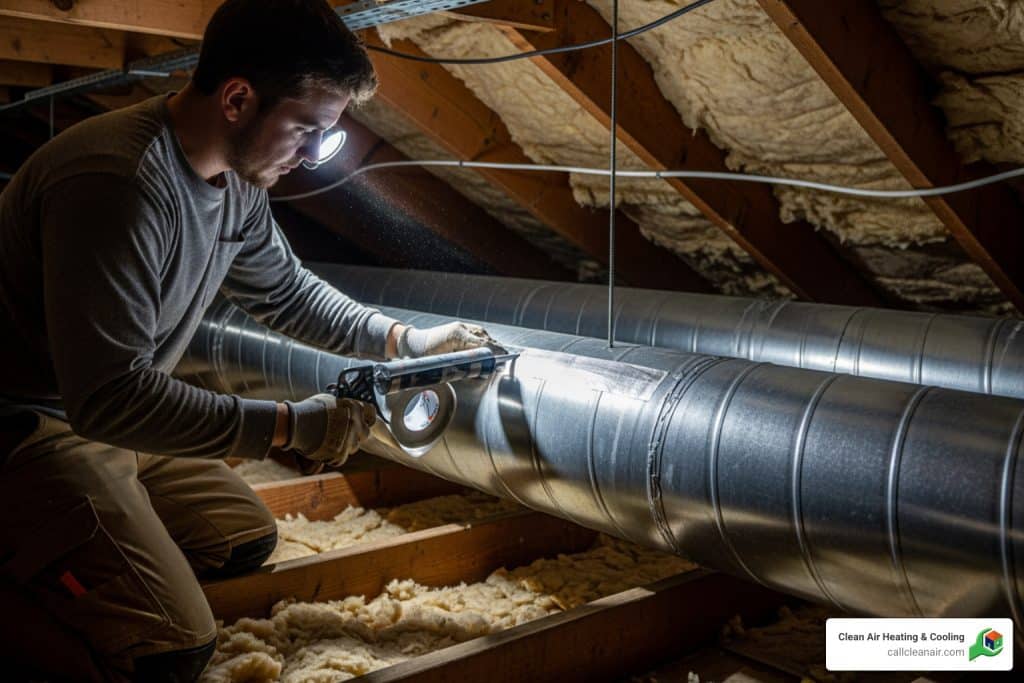
If you can actually reach your ductwork—say, in an unfinished basement or accessible attic—manual sealing can be remarkably effective. But here’s where most homeowners make their first mistake: they reach for that roll of grey cloth-backed “duct tape” sitting in the garage. I know, it’s right there in the name, but here’s the irony: traditional duct tape is terrible for sealing ducts. The adhesive dries out when exposed to temperature changes, and it typically fails within a year or two. It’s great for a hundred other things around the house, just not the one thing it’s named for.
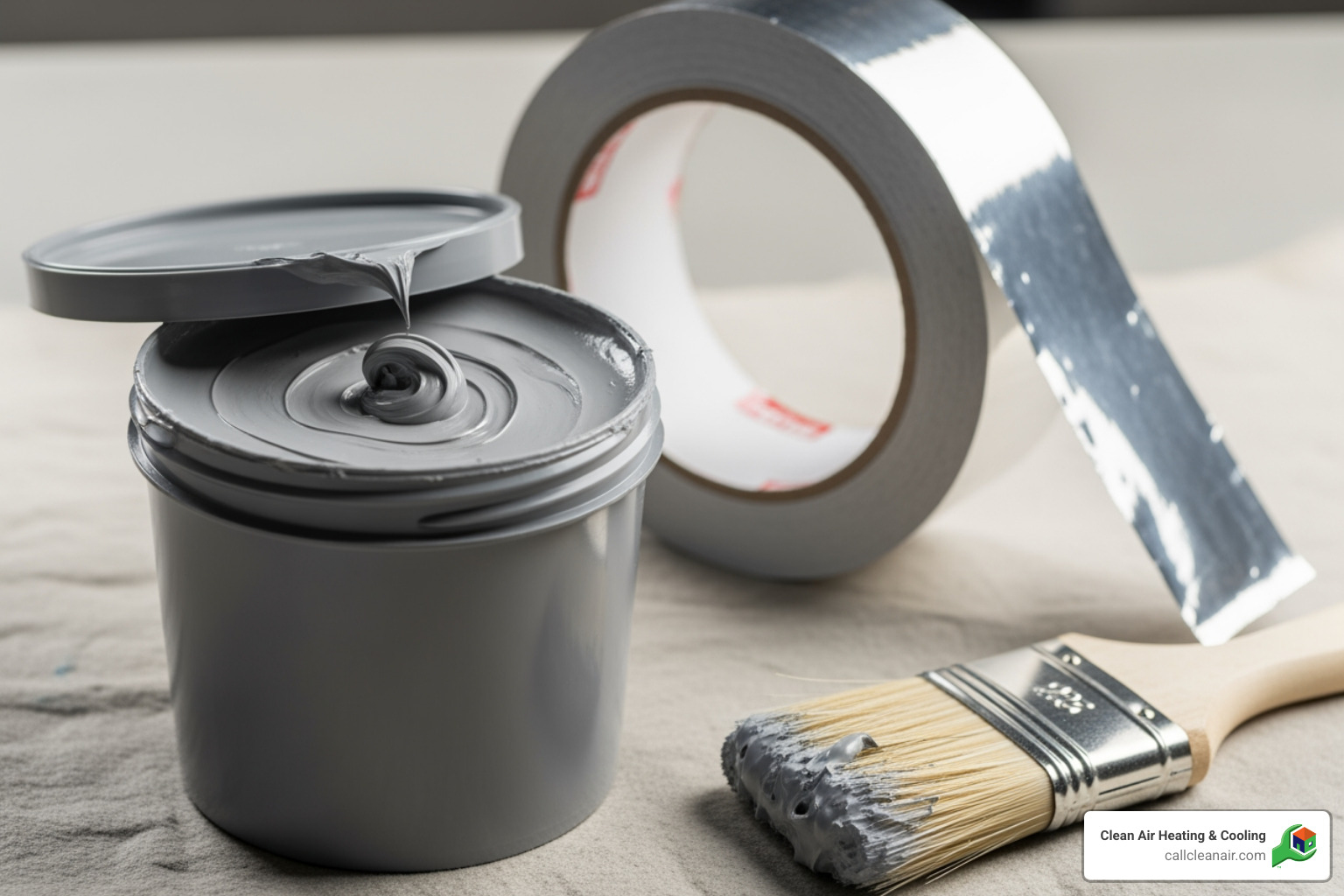
Instead, we rely on two proven materials: mastic sealant and foil tape (also called metallic tape or UL 181-rated tape). Each has its strengths, and smart duct sealing often uses both. Water-based mastic is particularly forgiving and easy to work with, while fiberglass mesh tape can reinforce larger gaps before applying mastic over the top.
| Feature | Mastic Sealant | Foil Tape (UL 181-Rated) |
|---|---|---|
| Durability | Extremely durable; lasts decades when properly applied; remains flexible through temperature changes | Very durable when high-quality; can last 10+ years; may require eventual re-application in extreme conditions |
| Application | Brushed or troweled onto joints and seams; works well for irregular surfaces and larger gaps; can be messy to work with | Pressed firmly onto clean, smooth surfaces; quick and clean application; requires smooth surface for good adhesion |
| Best Use Cases | Ideal for joints, large gaps, irregular connections, and areas where tape won’t adhere well; can be built up in layers for bigger repairs | Perfect for straight seams, small gaps, and smooth metal-to-metal connections; excellent for reinforcing mastic seals |
Mastic sealant is the gold standard for permanent duct sealing. This thick, paste-like substance is applied with a brush or gloved hand directly onto joints, seams, and gaps. It stays flexible as it cures, so it won’t crack when your ducts expand and contract with temperature changes. Mastic can fill irregular gaps and works on almost any surface. The downside? It’s messy to work with, and you’ll want to wear old clothes and gloves.
Foil tape, when it’s the real UL 181-rated stuff, creates an excellent seal on smooth surfaces. It’s much easier and cleaner to apply than mastic—just peel off the backing, press it firmly onto a clean surface, and you’re done. It works beautifully on straight seams and metal-to-metal connections. The catch is that the surface needs to be smooth and clean for the adhesive to bond properly, and it’s not ideal for irregular gaps or corners.
Many professional HVAC techs (including our team) use both: foil tape for accessible straight seams and clean connections, then mastic for everything else—joints, corners, irregular surfaces, and as reinforcement over the tape for extra insurance.
Advanced Sealing: How Aeroseal Technology Works
Now, here’s where duct sealing gets really interesting. What if you could seal all those hidden leaks—the ones buried in walls, tucked behind finished ceilings, or snaking through inaccessible crawlspaces—without tearing your house apart? That’s exactly what Aeroseal technology does, and it’s genuinely one of the most impressive innovations I’ve seen in my years in this business.
Aeroseal works from the inside out, which is the complete opposite of traditional manual sealing. Here’s the process: we temporarily block off all your registers and vents, then pressurize your duct system. Next, we inject an aerosolized polymer sealant—tiny sticky particles suspended in air—into the ducts. As air escapes through leaks, these particles get carried along with it. When they reach a hole or gap, they stick to the edges and gradually build up, layer by layer, until the leak is sealed. It’s like the leak seals itself.
The beauty of this approach is that the sealant only accumulates where air is actually escaping. Your ductwork stays clean, and those hard-to-reach leaks that would be impossible to seal manually get addressed automatically. The entire process typically takes just a few hours, and you get measurable, documented results. In fact, Aeroseal can reduce duct leakage by an average of 94 percent—that’s not a typo. We’re talking about sealing nearly all the air loss in your system.
Before and after the Aeroseal treatment, we measure exactly how much air is leaking from your system, so you have concrete data showing the improvement. It’s not guesswork or estimates; you see the actual numbers proving that your ducts are now sealed tight.
If you’re curious about whether Aeroseal might be right for your home, check out our Aeroseal service page for more details on how this technology can transform your home’s comfort and efficiency.