Geothermal Ground Loop Installation: Unlock 70% Savings
Why Geothermal Ground Loop Installation is a Game-Changer for Northwest Homeowners
Geothermal ground loop installation is the process of burying a network of pipes to harness the earth’s constant temperature for home heating and cooling. This system transfers heat between your house and the ground, providing efficient, year-round comfort without burning fossil fuels. The earth maintains a stable temperature of around 55°F just a few feet below the surface. A geothermal ground loop takes advantage of this by circulating a water-based fluid through the pipes. In winter, the fluid absorbs heat from the ground and delivers it to your home; in summer, the process reverses, moving heat from your home into the cooler ground.
Quick Overview: What You Need to Know
- Installation Types: Horizontal (trenched 6-8 feet deep), Vertical (drilled 150-400 feet), or Pond/Lake loops
- Timeline: Typically 2-4 weeks from site evaluation to completion
- Lifespan: Ground loops last 50-100+ years; heat pumps last 20-25 years
- Efficiency: Geothermal systems achieve 300-500% efficiency ratings
- Savings: Up to 70% reduction in heating and cooling bills
- Investment: System costs range from $20,000-$40,000 with a 30% federal tax credit available
As the Owner and President of Clean Air Heating & Cooling, I’ve helped countless homeowners in Whatcom, Skagit, and Snohomish County steer the geothermal ground loop installation process. My team ensures every system is sized and installed correctly for decades of reliable comfort, making the installation as smooth and transparent as possible.
Geothermal ground loop installation word roundup:
What is a Geothermal Ground Loop and How Does It Work?
A geothermal ground loop is a network of durable plastic pipes buried on your property, designed to tap into the earth’s stable underground temperature of around 55°F. This constant temperature makes the ground an ideal heat source in winter and a heat sink in summer.
A geothermal system doesn’t create heat by burning fuel; it simply moves existing heat. A heat pump circulates a water-based fluid through the ground loop to transfer warmth between your home and the earth.
- During winter heating, the fluid absorbs warmth from the ground. This heat is then concentrated by the indoor heat pump and distributed through your home. The cooled fluid returns to the ground to absorb more heat.
- During summer cooling, the process reverses. The heat pump extracts heat from your indoor air, transfers it to the fluid, and carries it into the cooler earth. The cooled fluid then returns to absorb more indoor heat.
This heat transfer process results in incredible system efficiency ratings of 300% to 500%, meaning for every unit of electricity used, you get three to five units of heating or cooling. This can lead to utility savings of up to 70%.
The Core Components of a Geothermal System
Every geothermal system has three essential parts:
- The underground loop (ground heat exchanger) is the network of buried pipes that exchanges heat with the earth. These loops are built to last 50 to 100 years or more.
- The heat pump unit, located inside your home, is the system’s control center where heat is extracted and concentrated. It has a lifespan of 20 to 25 years.
- The distribution system delivers conditioned air or water throughout your home, typically using existing ductwork or a hydronic system for radiant floor heating.
How Ground Loops Contribute to Energy Savings
The secret to geothermal’s savings is that it transfers heat instead of creating it. Traditional furnaces and air conditioners consume large amounts of energy to generate heat or fight hot summer air. Geothermal systems simply shuttle heat using a small amount of electricity to power the compressor and pumps.
This efficiency means reduced electricity demand. The 300-500% efficiency ratings are real measurements of the energy you get versus the energy you use. As a bonus, geothermal systems can provide hot water preheating, capturing excess heat to warm your domestic water supply and potentially cutting water heating costs by 50% or more.
While the upfront cost of a geothermal ground loop installation is higher than conventional systems, the lower monthly bills, long lifespan, and minimal maintenance provide a substantial long-term return on investment, often paying for itself within 5 to 10 years.
Comparing Ground Loop Systems: Which is Right for You?
Choosing the right ground loop for your geothermal ground loop installation depends on your property’s size, soil type, and geology. Systems are either closed-loop (most common), which circulates fluid in a sealed network, or open-loop, which uses groundwater from a well.
Here’s a quick comparison of your options:
| Loop Type | Installation Method | Land Area Required | Best Use Case |
|---|---|---|---|
| Horizontal Loop | Trenched 5-10 ft deep | Large (1/2 acre+) | Ample yard space, suitable soil for trenching |
| Vertical Loop | Drilled 150-500 ft deep | Small (limited footprint) | Limited yard space, urban/suburban lots, rocky soil |
| Pond/Lake Loop | Coiled pipes submerged in water body | Nearby water source | Properties adjacent to suitable ponds or lakes |
| Open Loop | Two wells (supply & discharge) | Abundant, clean groundwater | Properties with high-quality, high-volume well water |
Proper loop design and installation are critical for system performance. Soil conditions are also key; moist soil transfers heat better than dry, sandy soil.
Horizontal Ground Loops
If you have a large yard, horizontal loops are often the most cost-effective option. We use an excavator to dig trenches 5 to 10 feet deep, lay coils of durable pipe, and then backfill the trenches. A mid-sized home might require over 3,600 linear feet of piping, needing at least half an acre of land. For smaller areas, a “slinky” configuration coils the pipe to fit a more compact space. The main advantage is lower cost due to the absence of specialized drilling equipment, but the trade-off is the significant land area required.
Vertical Ground Loops
When space is limited or the geology is challenging, vertical loops are the ideal solution for your geothermal ground loop installation. We use a drilling rig to bore holes 150 to 500 feet deep and about 5 to 6 inches in diameter, spaced 10 to 20 feet apart. U-bend pipe loops are inserted, and the borehole is filled with grout to ensure excellent thermal contact and protect groundwater. The main advantage is the minimal surface footprint, making them perfect for suburban lots in Whatcom, Skagit, and Snohomish County. The downside is a higher upfront cost due to the specialized equipment and expertise required.

Pond/Lake and Open Loop Systems
For properties with specific features, two other options exist.
A pond or lake loop is viable if you have a nearby body of water that is at least half an acre in size and 8-12 feet deep year-round. Coils of pipe are submerged and anchored to the bottom, using the water’s stable temperature for heat exchange.
Open-loop systems use groundwater directly. Water is drawn from a supply well, circulated through the heat pump, and returned to the aquifer via a discharge well. This requires an abundant source of clean well water and is subject to local discharge regulations. While potentially very efficient, these systems are less common due to their site-specific requirements and regulatory problems.
The Geothermal Ground Loop Installation Process Step-by-Step
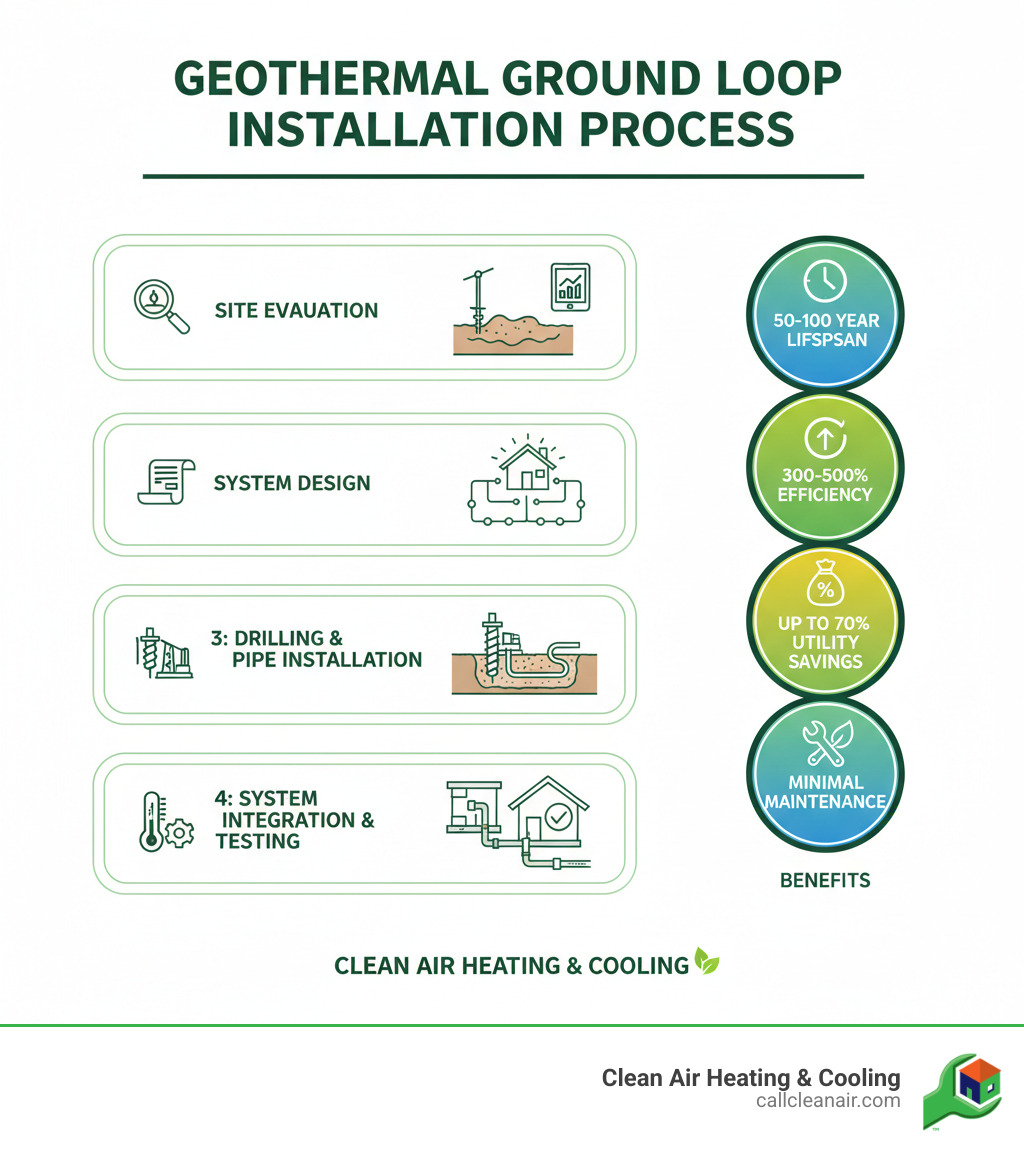
A geothermal ground loop installation with Clean Air Heating & Cooling is a structured process that typically takes 2 to 4 weeks. Our IGSHPA certified professionals ensure your installation meets the highest industry standards, whether for a new build or a retrofit into an existing home.
Step 1: Site Evaluation and Feasibility
The process begins with a comprehensive site evaluation at your property. This first step includes:
- Analyzing Home Energy Demand: We calculate your home’s heating and cooling load based on its size, insulation, and energy use.
- Assessing Soil and Geology: We examine soil type and thermal conductivity to determine the most effective loop type and design.
- Determining Land Availability: We measure your outdoor space to decide if a horizontal, vertical, or pond loop is most suitable.
- Reviewing Existing HVAC Setup: For retrofits, we inspect current ductwork to plan for seamless integration.
Step 2: System Design and Sizing
Next, our engineers design a geothermal system custom to your home and property. This involves:
- Custom Loop Field Layout: We design the most efficient arrangement for your ground loops, whether it’s a pattern of trenches or a series of boreholes.
- Heat Pump Sizing: We select the correctly sized heat pump unit to match your home’s calculated heating and cooling load.
- Ductwork Compatibility: We confirm your ductwork is adequate or recommend modifications for optimal airflow.
- Determining Loop Length and Depth: We precisely calculate the required pipe length. A horizontal loop may need 100-250 feet of trench per ton of capacity, while a vertical loop often requires 150-250 feet of bore depth per ton.
Step 3: The Geothermal Ground Loop Installation
This is the physical installation phase, involving significant earthwork.
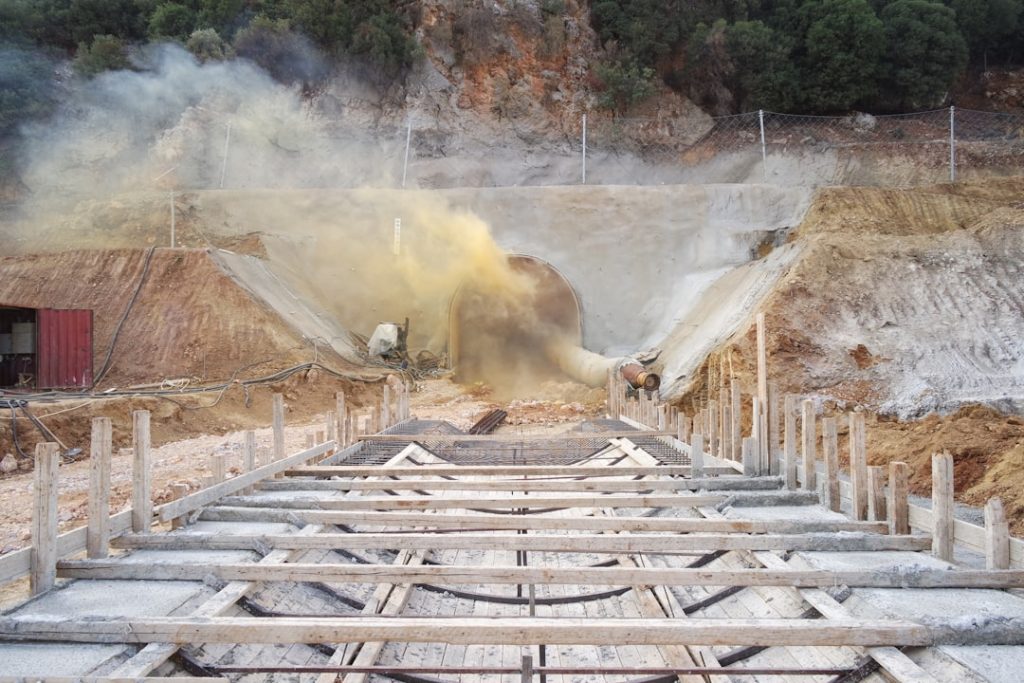
- Drilling or Trenching: Our crews use excavators for horizontal trenches or drilling rigs for vertical bores.
- Pipe Placement: Durable polyethylene pipes are carefully laid. For vertical systems, U-bend pipes are inserted into boreholes, which are then grouted from the bottom up to ensure proper heat transfer and seal the bore.
- Manifold Connection: Individual loops are connected to a manifold, which directs fluid flow to and from the heat pump.
- Backfilling and Site Restoration: Trenches or boreholes are backfilled, and our team works to restore your property. We recommend waiting about a year for the ground to settle before major landscaping.
Step 4: System Integration and Commissioning
With the loops installed, we bring the system online.
- Connecting to Indoor Unit: The ground loop manifold is connected to the indoor geothermal heat pump.
- Flushing and Pressurizing: The loop is flushed of air, filled with a water/non-toxic antifreeze solution, and pressurized. We test for leaks to ensure a perfectly sealed system.
- Final Testing: We verify fluid flow rates and heat exchange efficiency, checking all electrical connections and controls.
- System Start-up and Calibration: We start the system, calibrate all settings, and perform performance tests. We then walk you through your new system’s operation and maintenance.
Sizing, Costs, and Materials for Your Installation
Understanding the numbers behind a geothermal ground loop installation helps you make a confident decision. The total investment depends on your home’s size, the loop type you choose, and site accessibility. The good news is a 30% federal tax credit is currently available for geothermal installations, which can significantly reduce your out-of-pocket cost, along with other local incentives.
How is the Size of a Geothermal Ground Loop Determined?
Sizing a ground loop is a precise science. The process starts with a detailed heat loss calculation that analyzes your home’s insulation, windows, and air leakage to determine its exact heating and cooling needs. We also consider your climate zone and test your soil’s thermal conductivity, as moist clay soils transfer heat better than dry, sandy soils. These factors determine the required heat pump capacity (measured in tons) and the corresponding loop length. As a guideline, vertical loops need 150 to 250 feet of bore depth per ton, while horizontal loops require 100 to 250 feet of trench length per ton.
What Influences the Cost of a Geothermal Ground Loop Installation?
The investment for a complete geothermal ground loop installation typically falls between $20,000 and $40,000. This upfront cost covers a system where the ground loop lasts 50-100 years, while the indoor unit lasts 20-25 years.
- Loop Type: Vertical systems generally cost more than horizontal ones due to the need for specialized drilling rigs.
- Home Size: Larger homes require a larger loop field and heat pump, increasing material and labor costs.
- Site Conditions: Difficult terrain, limited access for equipment, or shallow bedrock can increase installation expenses.
- Permitting: Fees for drilling or excavation vary by location.
- New vs. Retrofit: Integrating a system during new construction is often more cost-effective, but retrofits can be seamless if suitable ductwork already exists.
Materials and Lifespan: What to Expect
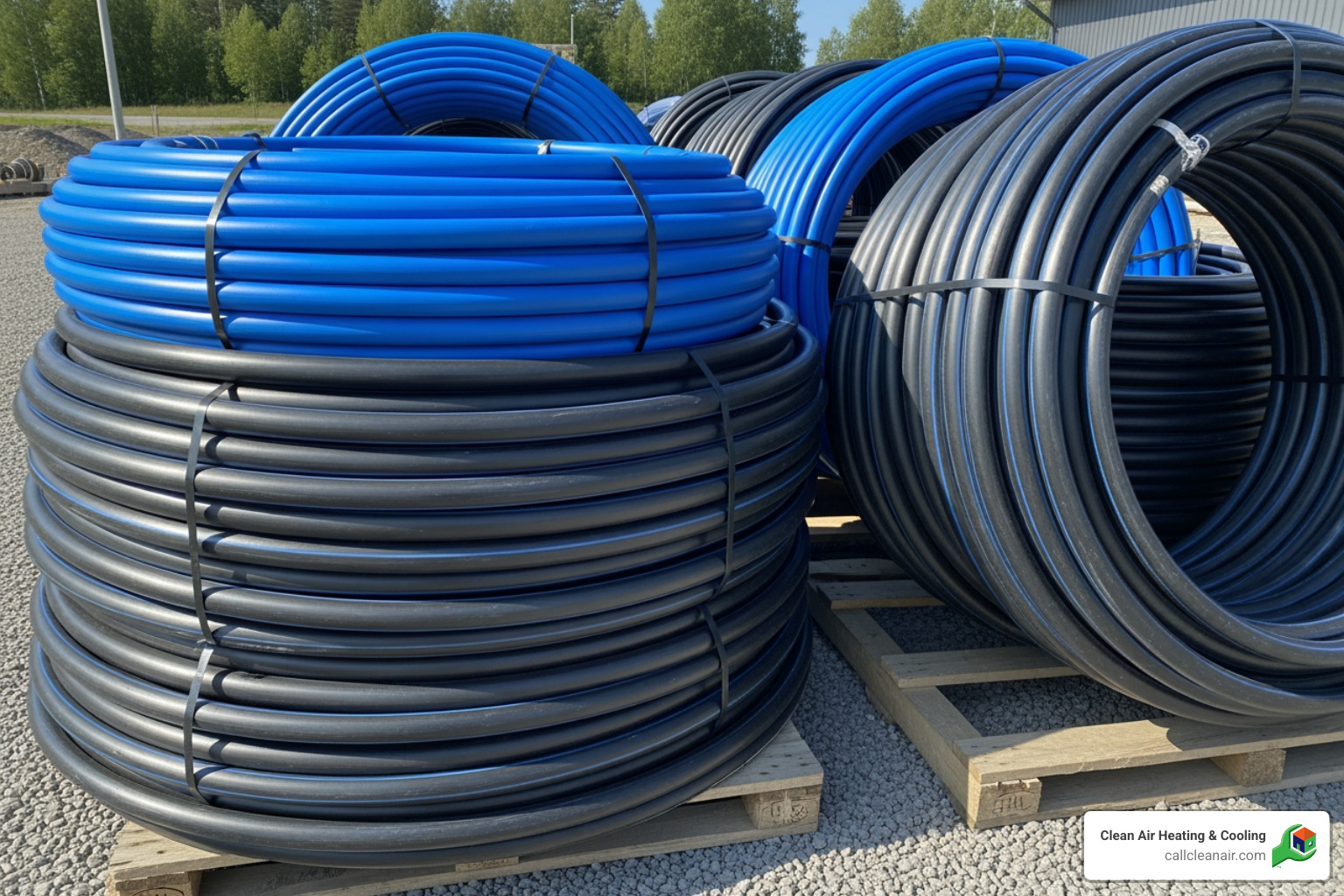
The materials used for your geothermal ground loop installation are built for extreme longevity. We use high-density polyethylene (HDPE) pipe, a durable, corrosion-resistant material that can withstand underground conditions for generations. Another approved material is crosslinked polyethylene (PEXa).
All underground pipe connections are made using heat fusion joints, which melt the pipe ends together to create a seamless bond that is stronger than the pipe itself. We never use buried mechanical fittings, as they are potential failure points.
The lifespan of these components is impressive. The indoor heat pump unit lasts 20 to 25 years, but the underground ground loop is designed to last 50 to 100 years or more. This longevity makes the ground loop a permanent, value-adding feature of your property. When the indoor unit eventually needs replacing, the most expensive part of the system is already in place and ready for another generation of service.
Post-Installation: Maintenance, Safety, and Land Use
Once your geothermal ground loop installation is complete, you can expect decades of reliable comfort with minimal maintenance. Our installation practices prioritize groundwater protection and adhere to all local regulations in Whatcom, Skagit, Snohomish, and San Juan Counties.
What Fluid is Used and Is It Safe?
The fluid in a closed-loop system is a simple water and antifreeze solution. The antifreeze is a non-toxic, food-grade propylene glycol, the same type found in many foods and cosmetics. This ensures the fluid is safe for your property and the environment. We never use toxic ethylene glycol (automotive antifreeze), which is strictly prohibited in geothermal systems. This is why choosing a certified professional for your geothermal ground loop installation is critical.
Maintenance and Potential Risks
The best news is that the ground loops themselves are essentially maintenance-free. Once installed, they work silently underground for decades without needing service.
While problems are rare, it’s good to be aware of potential risks:
- Leaks: Leaks are uncommon due to the durable HDPE pipe and strong heat-fused joints. The most likely cause of a leak would be accidental damage from future digging with heavy equipment. We conduct rigorous pressure testing to ensure a leak-free system upon installation.
- Hazardous Gases & Radon: During drilling, our crews follow safety protocols to monitor for any hazardous gases. The proper grouting and sealing of boreholes prevent any subsurface gas, including radon, from migrating. A geothermal system does not increase radon levels in a home.
Can I Build or Plant Over My Ground Loops?
Yes, you can use the land over your loop field, with a few considerations.
- Driving: Driving and parking vehicles over the loop field is perfectly fine.
- Building: Light structures like sheds or decks without deep foundations are generally not a problem. However, avoid building heavy structures with deep concrete footings (like a home addition) directly over the loops, as excavation could damage the pipes.
- Planting: Shallow-rooted plants, gardens, and lawns are fine. We advise against planting large trees with aggressive root systems directly over the pipes to prevent the risk of root intrusion over many decades. The slight soil temperature changes caused by the system can also affect certain deep-rooted trees.
Conclusion: A Smart Investment for Your Home
Choosing a geothermal ground loop installation is a long-term investment in your home’s comfort, value, and sustainability. By tapping into the earth’s stable temperature, you gain a heating and cooling system that will benefit your family for generations.
The advantages are clear:
- Dramatic Cost Savings: Reduce heating and cooling bills by up to 70%.
- Eco-Friendly: Use renewable energy with zero onsite emissions.
- Long Lifespan: The ground loop is designed to last 50-100+ years.
- Reliable Comfort: Enjoy quiet, consistent temperatures year-round.
At Clean Air Heating & Cooling, we specialize in designing and installing geothermal systems custom to the unique geology of Northwest Washington. As the Owner and President, I stand behind our work with a 25% utility savings guarantee. Our reputation, backed by over 480 5-star Google reviews, is built on quality and customer satisfaction.
We are proud to serve homeowners throughout Whatcom, Skagit, Snohomish, and San Juan Counties. If you’re ready to explore how geothermal can transform your home’s efficiency, we’re here to help.
Start your geothermal journey with a professional heat pump installation